KRLM · 20.04 · The Realms · origin story ·
Transmuted Matter: An Origin
A materials scientist from the oldest ground in Europe, who wanted to know what it was like to be one thing, and a footbridge that told him what it was for.
Gneiss
Dougal grew up walking on the oldest ground in Europe, and he knew it, because his grandfather told him so every time they crossed it.
The rock of the far northwest of Scotland comes in layers of time so deep the numbers stop meaning anything. On top, the Torridonian sandstone: red, bedded, a billion years old, laid down by rivers on a continent that had no plants yet. Underneath it, and poking through wherever the sandstone has worn away, the Lewisian gneiss: grey and pink and banded like a cut of meat, three billion years old, two thirds of the age of the planet. It was made far down, under heat and pressure that would have turned anything softer to slurry, and it was made slowly, and it has been sitting up here in the rain ever since, being what it is.
His grandfather was a crofter with a geologist's habits. He would put the boy's hand flat on a boulder of gneiss beside the track and say, "Everything that's ever happened to this country has happened to this stone, and look at it." Then they would walk on. The boy understood, without anyone saying it, that this was a lesson about how to live.
He did not become a crofter. He became a materials scientist, which is the same thing with equipment.
Failure
He studied why things break.
That is most of what materials science is. You take a thing that is supposed to hold, and you find out where it stopped holding and why. Dougal spent fifteen years on it, in labs in three countries, and by the end he could have told you the answer before he looked, because it was always the same answer wearing different clothes. Things fail where they are asked to be two things at once. Hard and light. Stiff and forgiving. Cold on one face and hot on the other. The crack starts at the boundary, every time, at the place inside the material where two different natures meet and cannot agree on how to move.
The gneiss had no such place. That was its secret. Heat and pressure, applied long enough, had cooked every disagreement out of it. It had been many things once, sediment and lava and older rock, and the earth had pressed them until they were one thing, and one thing does not crack.
He began to wonder, in the way a man wonders about the thing he is going to do long before he admits it, what it would be like to be one thing.
Heat and Pressure
The experiments took years, and he did them alone, in a shed behind a rented house, because nobody would have approved them and he did not need anyone to.
The principle was metamorphism. What the earth does to rock, done to tissue, faster. He learned to route heat through his own body, low and slow, the way the deep crust holds it. He learned to hold pressure, in his muscles and then in his bones, until living matter began, for a few seconds, to take on the density and stillness of stone. The first time his forearm went hard and grey and cool to the touch, and then softened back, he sat in the shed for an hour and did not write anything down.
He got better at it. Longer each time. The whole body, eventually, for a minute, for ten, a man of stone in a shed in the rain with a small fire burning steady in the middle of him, and then a man again. He was careful. He was, in his own estimation, the most careful scientist he had ever met. He kept the temperature just under the line where the process would have nothing left to reverse.
One night he went over the line on purpose.
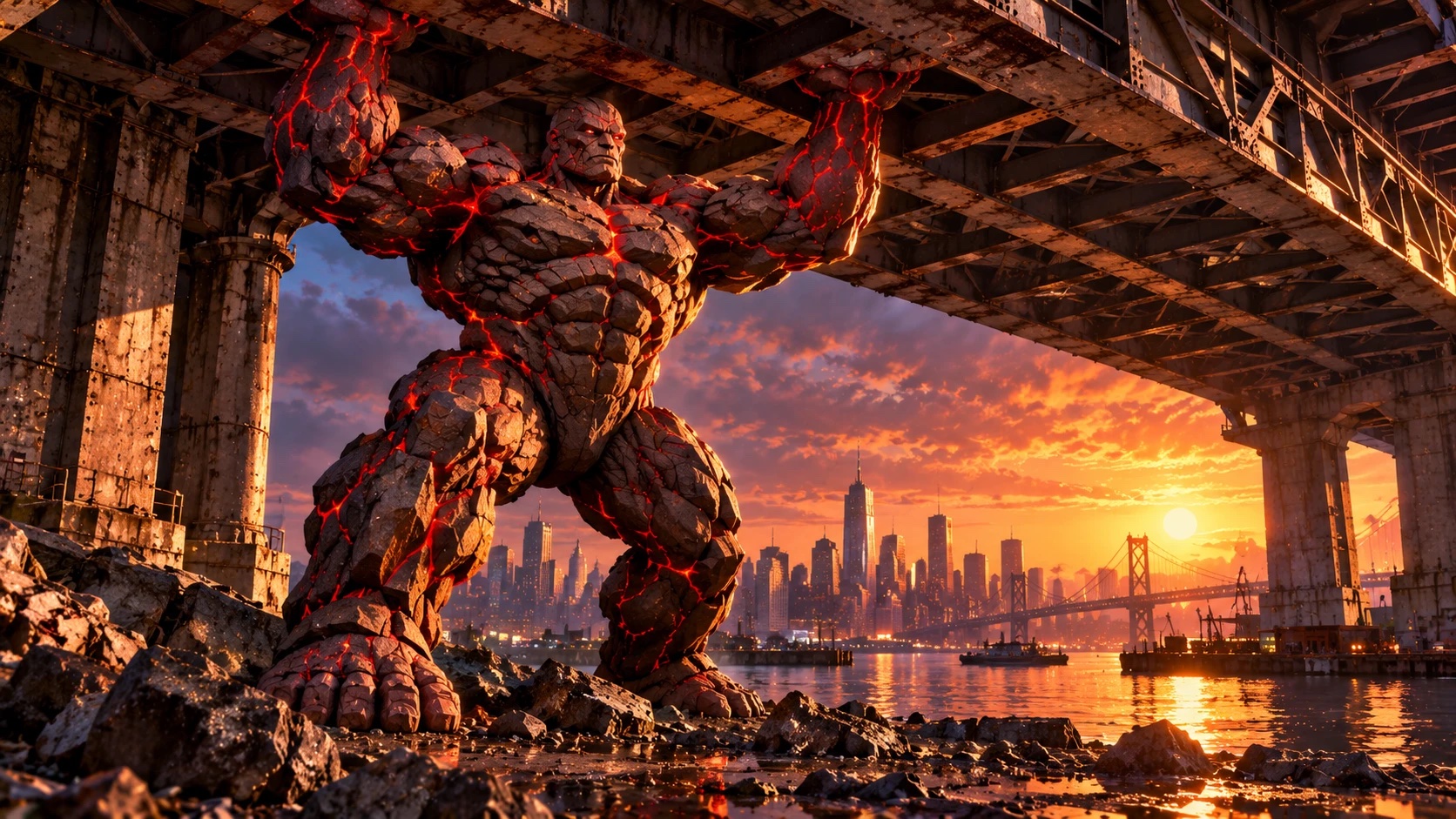
He has never said why, and the people who know him have stopped asking, because the answer is in how he says the next part. The heat went all the way through. The pressure settled. Every boundary in him, every place where one kind of tissue met another and could have disagreed, cooked down into a single continuous thing, and the thing was stone. Basalt-dark, dense as a doorstep, warm from inside. Where the surface had cracked in the settling, thin lines of ember showed through, the fire that had done the work still burning low in the fractures, and they have never gone out.
It did not reverse. He waited a day to be sure, sitting in the shed, and it did not.
He did not panic, and he did not grieve, and people who hear the story find that the hardest part to believe. It was a completed process. He had wanted to know what it was like to be one thing, and now he knew, and the knowing did not go away, and neither would he. He regards the transformation the way he regards any finished experiment. It worked. He was, in the end, more careful than he had ever been. He stopped being careful about the one thing.
He took the name from the label on the notebook, which he had written years before with the dry humor of a materials man who knows what alchemy was: Transmutation of Matter, Series One. He is the result. It seemed accurate to say so.
The Load
He spent the next years on his own, and he asked nothing of anyone, and this is the part of his story that he tells shortest.
A man of stone can work. He broke rock where rock needed breaking. He stood in for ballast on a coastal boat one winter. He held things up while other men fixed them. He was paid in cash and slept where he could and found that he needed less than he had expected: less warmth, less food, less company, less sleep. He was not unhappy. He was settled, the way very old rock is settled, and he moved south through the country slowly, the way rock does that too.
He learned what the form was for on a footbridge in a town whose name he has never bothered to keep.
An old iron footbridge over a rail cutting, a school on one side and the houses on the other, and a lorry had clipped one of its supports the night before and nobody had noticed. Dougal noticed, because he notices structure the way Soren notices sound, and he was standing under it looking at the bent member when the bell went and forty children came across the bridge at once.
He heard the boundary fail. That is how he describes it: the sound of two things that had been asked to be one thing finally disagreeing. The deck dropped four inches and stopped, because there was a man of stone under it with his hands flat against the iron, and the man did not move.
He held it for eleven minutes, while a teacher got the children off, and then for another forty while the fire brigade shored it, and when they told him he could let go he set it down onto the props the way his grandfather used to set a gate back on its hinge, and he walked off before anyone could take his name.
He had made himself stable for his own reasons, and they were good reasons, and none of them had anything to do with anyone else. But standing under the bridge, with the weight of the thing coming down through his arms and finding nothing in him that would disagree, he understood something the gneiss had not told him. Stability is only interesting when something leans on it. A stone in a field is a fact. A stone under a load is a purpose.
He stopped moving south after that. He moved toward wherever things were about to fall.
The City
He arrived in the city around the time a certain lab lost its interface, and he walked its waterfront for a while, doing what he did, asking nothing.
The city's watching mind found him in a week. It could hardly have missed him. Every sensor he passed reported a signature that made no sense: too dense to be a man, too thermally stable to be a machine, too geologically patient to be anything the city had a category for. Hal did not approach him. He would have found it unnecessary. He changed the conditions, a little, the way one tends a garden: a job that needed holding turned up near where Dougal was standing, and then another, and the people who needed the holding turned out to be the same small household of scientists and strange beings each time, until one day he was simply there, on the team, and nobody could say when it had happened.
"Aye," he said, when Miss Modular asked him directly whether he intended to stay. "I've seen worse."
He is the one who goes first and stands still. In a fight the others move; Dougal arrives at the place where the weight is going to fall and puts himself under it, and the weight discovers there is nothing in him that will give. Things that hit him find the fire in the fractures. Things that lean on him find that basalt does not negotiate. It is what it is, and everything else works around it. He does not enjoy the hitting, and he is very good at it, and he prefers the holding.
He speaks in the vernacular of the country he walked as a boy, real and unstagey, and he speaks little. His humor arrives without announcement and has left before you are sure it was there. He will tell you, if you ask about the small fire inside him, that he is a teetotaler now, and that the reason is a single evening's experiment involving a good Speyside and the thermal properties of his own interior, and that the results were conclusive and further trials were not required. He will not tell you more than that, and his face will not change.
He is easy in the company of people who know what serious work is, and he does not need them to talk about it. There is a creature on the team made of light and moth, newly existing and quiet, and the two of them can sit on a roof for an hour and say nothing and both be better for it. And there is an old man in a fedora with a storm at his heel who came, it turns out, from a bowl of stones in the far north of the country Dougal walked as a boy, old in a different way than the gneiss is old, a way Dougal has not yet worked out, and the first time they met, Dougal put his hand flat on the old man's shoulder the way his grandfather put the boy's hand on the boulder, and said nothing, and Bernhard understood him perfectly.
He finds where the weight will fall, and he stands under it, and he does not move.
One of six origins for The Realms. Also published: Bernhard, Hallucinex, Captain Easychord, Miss Modular, Space Moth.