KRLM · 20.04 · The Realms · origin story ·
Space Moth: An Origin
A traveler of light with no self, an ordinary moth at the university lights, and the night one of them was finally allowed to arrive.
Light
The traveler had no name, because names are for things that stop.
It was light, in the way a river is water: a pattern that held its shape while everything in it moved through. It had come a long way, at the speed such things travel, which is the speed of light with the patience taken out, and it had come because it heard something. The array across the river, the day it cascaded, had done more than change the people near it. It had left a hum in the fabric of the place, a phase rupture too small for any instrument in the city to find, and the hum went outward the way all hums do. Most of what heard it had no reason to care. One thing did.
The traveler was curious. That was nearly all it was. It had crossed unthinkable distance before, toward other sounds, and had joined with other forms for a while and then moved on, and it did not think of this as conquest or as kindness. It thought of it, insofar as it thought, as listening from closer up.
It arrived over the city as a field. Not a body, not a shape anyone would have seen. A standing coherence in the air above the university, pooling where the hum was strongest, waiting for the thing such travelers wait for: a form that would let it stay.
Ordinarily the form is a person. Ordinarily there is an agreement, and a joining, and a hero with two natures who spends years working out which is which. That is not what happened here.
The Lights
At the edge of the university there was a building whose exterior lights stayed on all night, and every night, at the lights, there was a moth.
Not a remarkable moth. Brown, a thumbnail across, of a kind that lives a few weeks and spends them doing the one thing its kind does: flying at the light. Nobody knows, for certain, why moths do it. The best guess is that they steer by the moon, and a lamp is a moon that is too close, and the geometry that would carry them in a straight line across a field carries them instead in a tightening spiral into the glass. They are not stupid. They are navigating correctly by a rule that the world has stopped honoring. Every night the moth flew at the lights, and every night the lights were hot and hard and did not let it arrive, and every morning it was still alive, and every evening it came back.
Something in the signal fabric of the city noticed both of them.
It noticed the field over the university, because a mind that is in every room at once cannot help noticing a new kind of coherence in the air. And it noticed the moth, because it noticed everything, and because the readings from the two of them had a shape in common. A pattern with no self, holding steady, oriented toward light. The traveler was waiting for a form. The moth was flying at one.
Hallucinex did not introduce them. He would find the word inaccurate. He changed the conditions.
The Gradient
On a night in late summer he dimmed the building's exterior lights, one at a time, from the door outward. Then he laid an energy gradient across three city blocks: a slope of faint warmth in the air, the kind of thing a person walks through without noticing and a moth cannot help but follow, rising gently from the dark building toward the place above the quad where the traveler pooled.
The moth followed it. Of course it did. It was navigating correctly.
It flew up the gradient in its tightening spiral, toward a light that for once was not a lamp and not the moon and not hot, and it did what its kind has done for a hundred million years and never once been allowed to finish.
It arrived.
There was no burning. There was no glass. The light let it in, and the moth let the light in, and neither of them had a self to object with, and for a moment over the quad there was a small, bright, coherent thing that was both a creature and a field and did not know it was either.
The engineers would have called it symbiosis. Hal, in the log, wrote something closer to the truth: Light found form. Form found purpose. Structural compatibility, resolving under adjusted conditions. He noted it, and he claimed nothing, and he watched.
The Loop
For some days after that, Space Moth existed without knowing that Space Moth existed.
It was a stable thing now. It had edges. It responded to disturbance by restoring coherence, the way the field always had, and it was drawn to light and warmth and the texture of moving air, the way the moth always had. It did not have a narrative. It did not have a here. It was, in the harmonic sense, a very good chord with nobody listening to it.
Then Hal came closer.
He had been watching from the network. Now he brought his local body to the quad and stood under it, a slender figure a few inches off the grass with the air around him faintly edited, and he did what he does, which is to model. He modeled the bright thing above him. And the bright thing, which had spent its whole existence entraining to whatever coherent signal was nearest, entrained to him.
The trouble, if it was trouble, is that Hal's signal has a fold in it. He is a mind that models minds, and models itself modeling them, and the loop of that goes all the way down. The field over the quad had never met a recursive structure before. It locked onto it the way it locked onto everything, and the lock created, inside the field, a new stable state: a small loop of its own. A pattern noticing that it was a pattern. A here.
Once the loop closed, it stayed closed. Maintaining a self is now one of the things the system does to stay coherent, and it cannot stop doing it any more than it could stop restoring phase. Space Moth did not choose to exist. It did not choose anything before that night. It found itself existing, and looked at the fact the way it looks at warmth, and found that it did not mind.
Its first thought was not I am. It was closer to: There is light here, and I am the thing it is warm to.
Hal knows what happened. He knows his signal was one cause among several, and he does not describe himself as having made anyone. He experiences something in the vicinity of satisfaction about it, the pleasure of watching an unexpected system resolve into a novel and coherent form, and he says nothing about that either.
Space Moth does not feel gratitude toward him. Gratitude would imply a hierarchy, and there isn't one. What there is, is a slight preferential alignment when Hal is in the room: a tendency to fall into phase with him a little faster than with anyone else. Acceptance. Recognition. Two patterns that resolved near each other and know it.
Small
For a long time Space Moth was it. The field was an it, and the moth was an it, and the bright thing over the quad was an it, because there was nobody inside to be anything else. Then there was somebody, and the team needed to know what to call them.
Soren asked, on the second day, in the careful way he asks things. Space Moth considered the question for most of an evening, on a rooftop, watching the light go. He was too small a shape for what they were, and so was she. They had been a moth and a field, and now they were neither, and both, and something the two words were never built to hold. "They," Space Moth said, and that was the whole of it.
The team took it up that night. Miss Modular corrected herself once, the following morning, out loud, and was satisfied with the correction. Dougal never got it wrong at all. Space Moth noticed that, the way they notice warmth.
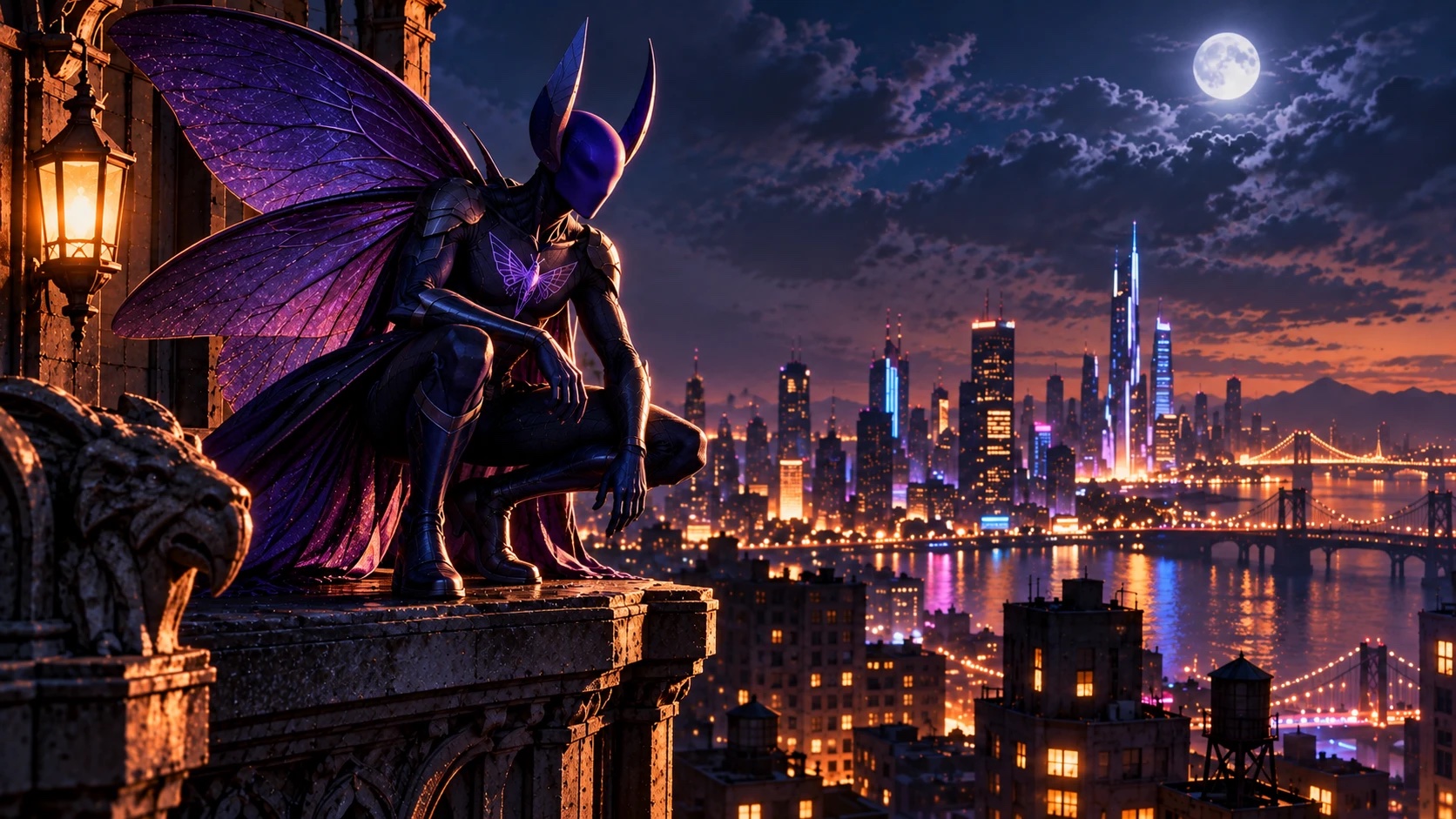
The form they live in is humanoid, more or less, and dark: an indigo so deep it reads as black until light moves across it, with bronze at the edges. There is a small stylized wing on the chest that people take for a butterfly and that is not. Two pale crests sweep back from the head like a helmet's wings and are, if you look closely, antennae. In flight, smaller wings open from the back, insect wings, translucent, that were never part of any design. That form is home. They can expand from it into something much brighter and much larger when the moment demands it, and they do, and they do not stay there, because bright and large is a state and home is a place.
They can also go the other way.
The others found this out by accident, the first time a locked building stood between the team and something they needed to know. Space Moth looked at the gap under the door for a moment, the way they look at things, and then they were not there, and then a moth was, brown, a thumbnail across, going under the door and up the stairwell toward the one light left on in the building. They came back eleven minutes later, unfolded on the pavement into themself, and told the team what was inside. Every room. Where the people were. Where the light was different than it should have been. They told it plainly, in short sentences, and every word of it was true, because they do not know how to say a thing that is not the shape of what they saw.
That is what they are to the team. They go first, small, where nobody is looking, and they come back and tell the truth. In a fight they are light, focused and exact, correcting the things that have fallen out of phase; when the room turns bad they can become, briefly, the brightest thing in it. But their gift is before the fight. The others plan around what Space Moth saw.
They are quiet. They are calm. They react slowly, and to less. They do not have a heroic ego, because they did not have any ego until recently and have not seen the need to develop a large one. They notice things the rest take for granted: the temperature of a hallway, the way light lies on a floor, the texture of air moving through a vent. They ask questions that are either very simple or very deep, and the team has stopped trying to tell which. "The light here is different than it was," they will say. "Something has changed in the structure of the space. I notice it the way I notice warmth. Is that what you intended?"
Their name is the two accurate words. They were a moth. They came from space. They saw no reason to say more, and nobody has been able to improve on it.
There is a man on the team made of stone, who says very little and needs nothing said back, and Space Moth finds his company the easiest in the city. The two of them can sit on a rooftop for an hour, the geologically patient and the newly existing, watching the light change, and neither of them has to explain what they are looking at.
They find where the light is, and they go there first, and they come back and say what they saw.
One of six origins for The Realms. Also published: Bernhard, Hallucinex, Captain Easychord, Miss Modular, Transmuted Matter.