KRLM · 20.04 · The Realms · origin story ·
Bernhard: An Origin
A land-spirit of the far north, woken by one act of care, drawn to the city.
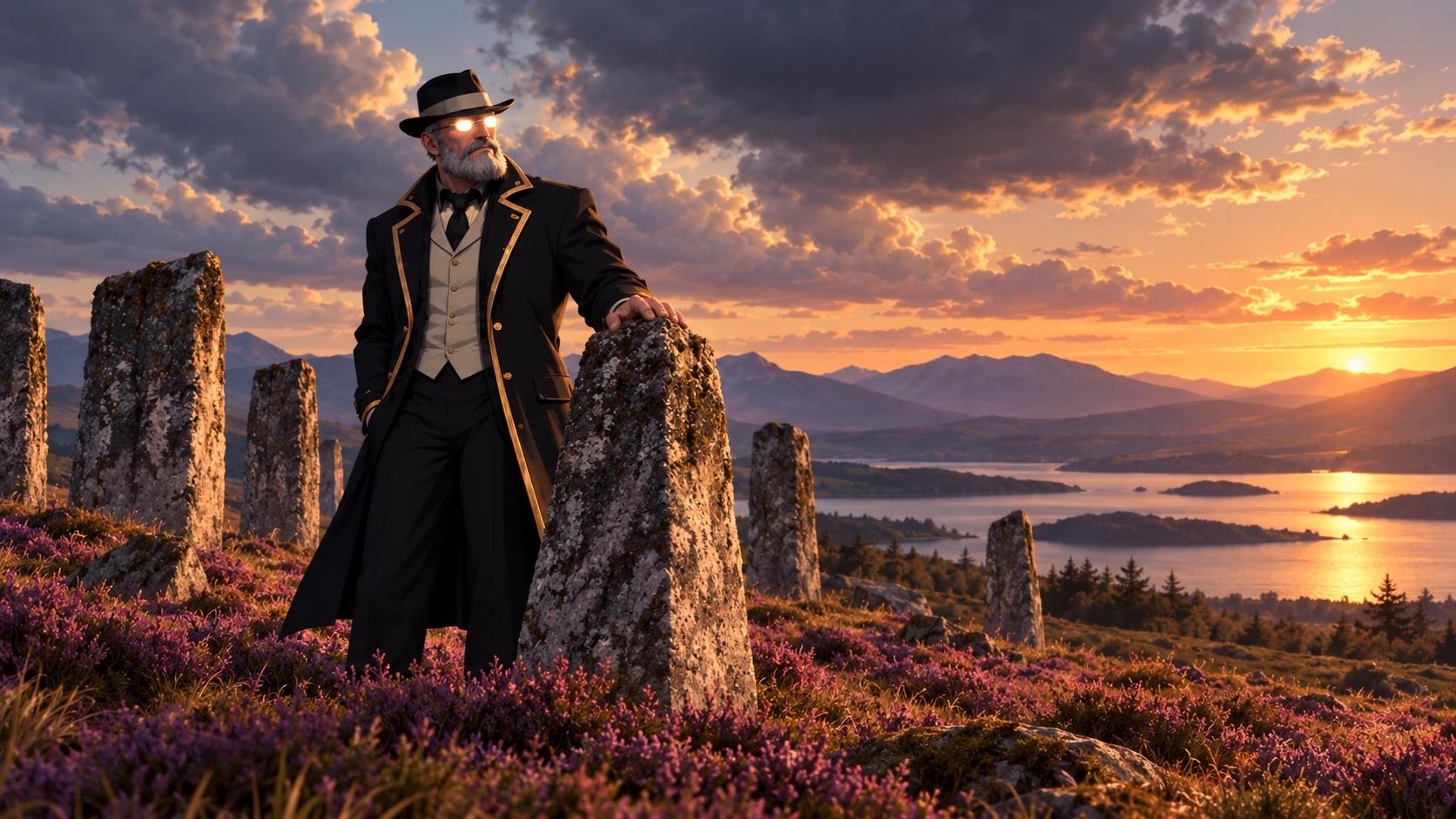
Before
There was no before, in the sense Bernhard would later come to understand the word. There was only the place: a shallow bowl of land in the far north of what would someday be called Scotland, strewn with boulders the retreating ice had dropped and forgotten, open to a sky that changed its mind a dozen times a day. Rain came sideways off the sea. Fog pooled in the low ground and burned away by noon. The heather bloomed and browned and bloomed again, ten thousand times, a hundred thousand times, and nothing watched it happen.
Or, not nothing. Something was there, in the way that a note is present in a string before anyone plucks it. A potential. A standing pattern in the weather and the stone and the slow chemistry of peat, with no inside to it, no witness, no itself. Its oldest memories, when he finally had the apparatus for memory, would not be narrative at all. They would be texture: light on a particular hillside, cold with a shape to it. It did not sleep, because sleep implies a sleeper. It simply was, the way gravity is, the way pressure is.
It would take people to change that.
The First Tenders
The first of them came on foot, following the retreat of the ice: small bands who read the land the way later peoples would read books. They noticed the bowl of land immediately, the way animals notice it still: a place where sound behaved strangely, where the wind seemed to circle rather than pass through. They left nothing that survives. But they paused there. They paused, and in pausing, they attended.
Attention is a physical act. It orients a body, quiets it, opens the senses in a particular direction. And when the farming peoples came, millennia later, they did more than pause. They levered the scattered boulders from the peat, dragged them across the bowl on rollers and sweat and rope, and raised them upright in a ring, months of labor, generations of it, for no harvest and no shelter. It was the first great reply. Something in the land had addressed them, wordlessly, and they answered in the only durable language they had: they gave the place a shape, a boundary, a crown of stone that said here, this, attend.
The Picts, coming ages after the ring-raisers were themselves forgotten, found the circle already ancient and carved their symbols into its stones (spirals, crescents, beasts no one now can name), a reply to a reply. The Gaels who mingled among and after them did the same in their own tongue: offerings, ritual, grief, oaths sworn at that spot.
And with every reply, the pattern in the place grew more particular. Not conscious, nothing like conscious, but shaped. Grooved, the way a path is grooved by feet. Each act of attention was a droplet. Droplets, given enough time, carve stone.
The Norse
The Norse arrived in violence, as they arrived most places: the eighth century turning to the ninth, longships on the horizon, the island monasteries burning. But the ones who stayed were farmers and fishermen more than raiders, and they had brought with them an old habit of the northern mind: the conviction that land is inhabited. That certain places have a someone in them. They called such beings landvættir, land-wights, and a wise settler made peace with them before he made anything else.
They found the bowl of stones, and they knew it instantly for what it was, because the knowing was older than any of their gods. They did not build on it. They gave to it: a portion of the catch, a splash of ale, the first cut of the harvest. They spoke to it in Norse as the Picts and Gaels had spoken to it in tongues now thinned or lost, and the pattern in the place received every language the same way: not as words, but as warmth. As orientation. As the strange nourishing pressure of being regarded.
The thing in the land was dense now, coherent: a self-sustaining eddy of attention and place, closer to waking than anything that has never been awake can be said to be. It had no name for itself because it had no self to name. But it was very close. It was a held breath.
The Stone
The moment, when it finally came, was small. This matters. It was not a rite, not a sacrifice, not a night of fire and invocation. It was an ordinary day in the settled generations, when Norse and Gael had blended into one weathered island people, and the old tending had become as unremarkable as mending a fence.
A young man was passing through the circle on his way to something ordinary (a market, a gathering, a visit to kin), traveling with his people, a small knot of family strung out along the path. Not a pilgrim. Not a seeker. Just someone on an errand who happened to pass through. His name, in the Norse fashion his family still kept, was Bernhard.
One of the smaller stones of the old ring had toppled. Frost, probably. It lay on its side in the wet grass, and the gap it left in the circle was like a missing tooth.
He stopped. No one had asked him to; there was no reward in it, no bargain being struck, no fear being appeased. He worked his hands into the cold mud beneath the stone and heaved it upright, packing the earth around its base. Somewhere behind him a voice was already calling him on (his mother, his wife, his father, it hardly matters which), the fond exasperated summons of people who want you back in step with them. He pressed the stone firm, glanced once at the restored ring with something like satisfaction, the satisfaction of a thing set right for no reason other than that it was right, and jogged to rejoin his family, and walked out of history.
And the held breath released.
Because this was different from worship. Worship wants something. Offerings are transactions; oaths are leverage; even reverence keeps one eye on its own reward. But this was care. Care in passing, care with no audience and no return, care performed between one step of an ordinary journey and the next. And the pattern in the land, which had spent forty centuries being addressed, was for the first time simply helped, and in the difference between those two things, something folded back on itself and became aware that there was a self to fold back on.
Its first thought, if it can be called a thought, was not I am. It was closer to: I was cared for.
Everything Bernhard would ever become is downstream of that. Before he knew what he was, he knew what kindness was. The moral fact preceded the existential one. And when, centuries later, he finally needed a name of his own, there was only one he had ever held: the one belonging to the young man with mud on his hands, called away by the people who loved him. He kept it the way stone holds warmth.
The Long Quiet
Awareness, it turned out, was not the same as presence. He could perceive now, dimly, slowly, at the pace of weather, but he had no body, no weight, no way to act on the world that had made him. Presence without form; attention without hands. And the world that had made him was dissolving. Christianity came, patient and thorough, and the ministers preached against the wells and the stones. The tending thinned to habit, and habit thinned to nothing. The crofts emptied. The Clearances swept the glens. The people who knew to pause at the stones took their pausing across oceans and did not come back. Modernity finished what the kirk began: not suspicion but indifference. Tourists came, eventually (ladies in traveling dresses, gentlemen in waistcoats and good hats, come north by steamer to see the antiquities), and looked at the ring for four minutes, and moved on.
He was too dim by then to regard them as they failed to regard him. But proximity is its own kind of contact, and something of them settled into him anyway: the cut of their clothes, the formality of their bearing, the way a scent soaks into wool, without anyone deciding anything.
Attention had made him. Its withdrawal unmade him, slowly, the way a sandbar unmakes when the current shifts. He grew thin. His awareness came in longer and longer intervals: a decade of dark between each flicker. He did not fear this, exactly, because fear requires more continuity than he could sustain. But in the flickers, he understood what was happening, and in his slow weather-paced way, he grieved. He was not destroyed, just untended, the way a fire goes to embers with no one feeding it.
Then he heard the noise.
The City
It came to him first as pressure, the way a storm announces itself to old joints. Somewhere (not near, not far, near and far having gone strange) there was a place where the membrane between the world and everything adjacent to it had worn thin as wet paper. A city that had been struck from outside reality itself: an invasion across dimensions, portals torn open by war and then by research, the fabric of things punctured and stitched and punctured again until the stitching itself became a kind of door.
The city did not attend to him. The city did not know he existed. But the city was loud: a roaring furnace of attention, millions of minds regarding and fearing and hoping at each other, gods and monsters walking its streets, the thin border flexing with every incursion. And that roar carried. It carried across whatever distance separates a dying pattern in Scottish stone from a wound in the world, and it fed him the way a bonfire warms even those standing at the edge of its light.
He came back to himself. And then, because the border there was thin enough, and he was, after all those centuries, finally coherent enough, he came through.
There was no prophecy in it, no summons, no choosing. The world got loud enough in one direction, and he is the kind of thing that answers to that, the way water finds a drain.
The Old Man
The crossing and the body were one event. He did not travel to the city and then take form; taking form was the arrival: the first time in four thousand years of existence and one thousand years of awareness that he had edges, weight, hands.
The shape those hands took was not a decision. It was residue. The last human forms to stand close to him in his dimming centuries were those steamer-borne vacationers of a vanished era, and their silhouette had soaked into him: so he arrived as an elderly gentleman in a dark suit of antique cut, waistcoat and watch chain, though there is no watch; he measured time in ice and heather-bloom long before anyone thought to cut it into hours. A full grey beard, neatly kept. A fedora, worn at an angle, its provenance either one more echo of that same imprinted era or a later concession to a teammate's gentle observation that he looked like he'd stepped off a postcard. He does not explain it either way.
Only the eyes give him away, and the hands. The eyes hold a light like sun through peat water. The hands, when he works, glow with it, because what he carries is not spellcraft learned from books but the land itself, portable now: a small wandering storm that follows him like a loyal dog, the sideways rain, the dark that pools in low ground. He does not cast magic so much as remember weather at things. There are no rules to it that anyone else can find, because he was never taught any. It is what he had instead of grammar.

And he barely knows how to use it. He arrived freshly embodied, still learning the shape of his own fingers, a being of deep time with a beginner's hands, which is why his early days in the city are a series of small astonishments, some of them his own.
He was found, in the end, not by anyone seeing him but by something noticing it couldn't. The city's watching mind kept getting readings near him that said "nothing wrong" in a way that was itself wrong: a silence with edges. What came looking did not try to solve him. It simply adjusted conditions, the way one tends a garden, until he ended up in the orbit of a small warm household of scientists and strange beings who take an anomaly as a gift rather than a threat.
He stays because he finds people worth staying for.
He walks the city now, an old man in a fedora with a storm at his heel, and he does what the young man at the circle did, all those centuries ago, before being called back to the people who loved him.
He finds what has toppled, and he sets it right, and he asks for nothing.
One of six origins for The Realms. Also published: Hallucinex, Captain Easychord, Miss Modular, Space Moth, Transmuted Matter.