KSUN · 19.81 · The New Sun · essay ·
Ifalong
Michael Coney's Song of Earth, read in 1983, and how much of the next forty years he'd already seen.
The year is 143,624 Cyclic, and a minstrel sits on a barren hillside telling the old stories of Earth to whoever gathers to hear them. Some evenings that's the Daughters of Starquin and the Dream-Essences and the ex-Keepers, in form or in spirit. Some evenings it's fifty chunky, hairy, manlike creatures sitting by the stream with their arms around their knees. He remembers everything except how he came to be, and what he didn't live through he's gleaned from the legends and the books and the computers of men. He says he is memory itself. "They call me Alan-Blue-Cloud," he says, and then he sings. That's the first page of The Celestial Steam Locomotive, which Michael Coney published in 1983, and I read it that year, in college in Minneapolis, because I remember how happy I was when Gods of the Greataway showed up the next spring and the story kept going. I read it again this spring, at a distance of forty-three years, and it was like seeing a dear old friend. The friend had aged well. Better than that, the friend had been right about a lot of things.
The Rainbow
Start with the frame, because it's the part that took me longest to appreciate. The whole novel is a playback. Alan-Blue-Cloud pulls stories out of the Rainbow, and the Rainbow gives him True Humans and Specialists, aliens and Bale Wolves, and the sad vat-bound people everyone calls Blubbers. Some of the stories are history. Some are the Ifalong, Coney's word for the future laid out as a landscape, and the Ifalong isn't one road. It branches at every significant choice into what he called happentracks, and the Rainbow can read down all of them.
That's the many-worlds idea, told as folklore, in a book that came out when the word "multiverse" belonged to comics and a few physicists. It's also a planetary archive that records everything and can be queried by anyone with the knack, which in 1983 was a fantasy and today is a description of the thing you're reading this on. Coney could have dressed it up as a machine, but he dressed it up as a legend, the one thing left when everything else has run down, and that's a shrewder guess about how people would relate to a total memory than most of the hard SF of the time.
Dream Earth
Most of the humans left on Earth live in Domes. Their bodies float in vats, fed and tended by the machines and by a caretaker caste called the Cuidadors. Their minds live somewhere else. The somewhere else is Dream Earth, a shared world the Rainbow runs for them, where nobody has to be the body in the vat. You pick a body. The Dream People wear famous faces out of the old records, a Marilyn, a Burt, and if you have the psy, the currency of the place, you can make a Bigwish and become someone new entirely, or a Smallwish and adjust the someone you already are. Wishing costs.
Read that list again. A persistent virtual world. Bodies in life support while the mind is elsewhere. Avatars chosen from a menu. A currency spent on identity. Sixteen years before The Matrix put people in pods, twenty years before Second Life put them in shops, and before the word "avatar" meant anything outside Hinduism and a 1986 Lucasfilm chat program most of us never saw. Coney had the whole stack, and he had the piece the later versions missed. Nobody in Dream Earth is a prisoner. They chose it, their ancestors chose it, and the bodies in the vats, the neotenites, have bred over the millennia into things that couldn't survive outside. Coney saw that the danger of a perfect virtual world was that you'd stay. He even gives the reason, through a historian in a later chapter who has worked it out from first principles: technology outruns people's ability to adapt to it, leisure breeds sedentary habits, and in the end people can't face the real world, so they build a safe place to dream forever and a storehouse of all knowledge to help them dream. That was written about a year after the IBM PC shipped.
The character who carries this is called the Girl. She's a Dream Person who makes the one wish nobody makes, which is to be herself, and wakes in the body she'd been hiding from. I'd started reading the Tao Te Ching around then, and the Girl's wish landed in the middle of that. Everyone else in Dream Earth is wishing to be someone. She wishes to stop. I didn't have the words for it at twenty, but the Taoist reading had started something in me, and that scene fed it.
The train
The plot, such as it is, follows three people the Rainbow calls the Triad. Manuel is a boy from a village on the shore near a Dome, an artist, one of the Wild Humans who never went inside, and he's looking for a girl he saw once and lost. Zozula is the Cuidador of that Dome, and when his assistant is dying he pulls a replacement out of Dream Earth, a Dream Person with no name, the one who wished to be herself. That's how the three of them end up together, and the Rainbow, which has been going strange, having absorbed a mathematical genius called the Mole and exiled him to the Land of Lost Dreams, needs them inside it to set things right. Something called Starquin, a being the book names the Five-in-One, has been held for ages by the Hate Bombs, and the Triad is the prophesied means of setting it loose. Starquin's agents on Earth are the Dedos, dedo being Spanish for finger. They're made in the shape of the planet's dominant species so they can walk among us, nudging happentracks toward the outcome Starquin needs. On the other side are the Bale Wolves, which hunt across happentracks the way wolves hunt across a valley.
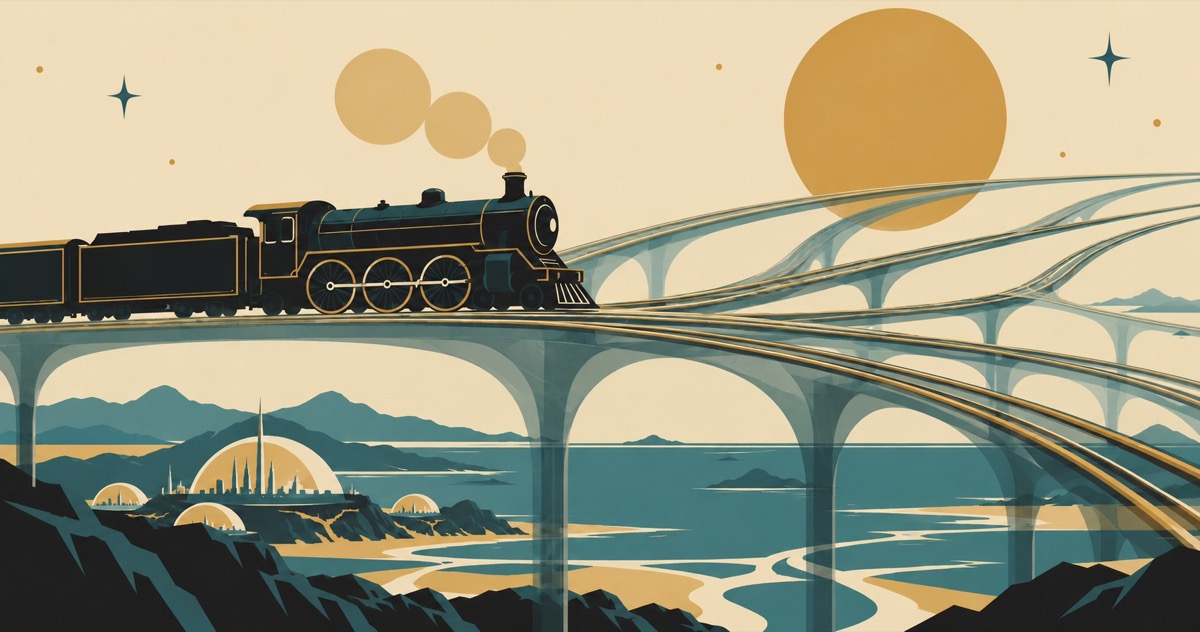
And the Celestial Steam Locomotive itself, which is a train. A Dream Earth train, a steam locomotive the way a child would draw one, that rolls through the happentracks and stops in any of them. One reviewer put it as well as I could: there are other worlds than these, and that train rolls through all of them. It's an image that stays with you for four decades when you're the son of a railroad engineer. Where another writer would have put a spaceship, Coney put the machine people in 1983 still loved, and let it run on rails nobody else could see.
The book is told as a song, and it rambles the way a song cycle rambles. There are stories inside stories, detours into villages and alternate futures, a chapter where the Triad meditate down into conversation with their own cells. People who want a plot that marches complain about it, and they're right that it doesn't march. I didn't want it to. I wanted to live there.
The detour I'd kept longest is a chapter called The Astral Builders. A river comes down out of the mountains behind Pu'este, past Dome Azul, through the rain forest to a flat delta, and on a triangular island a kilometer across, cold water and crocodiles on every side, lives a tribe Coney calls "the greatest and smallest civilization that Earth has ever known." They're sickly, sexless, sterile, dead by forty on average. They grow a few crops and fish when the mood takes them. And they lie down together in the mud and link their minds, five or six to a team, and climb out of their bodies into a shared place that isn't a place, where they build. Minarets into the clouds. Machines humming in chambers underground. Ships that go round the Galaxy. None of it exists outside the gestalt, and when one of the builders is shaken awake, a billion memory banks dissolve back into the ether and have to be built again. Going out to the work is cuerp and coming back is decuerp, and anyone who has sat through a Spanish class can hear the body in both words.
Once a year the river runs clear and green and brings them a flotilla of tiny balsa boats, model galleons and frigates and dhows, each with a crying baby in it, and the crocodiles come too. The babies are the Dome's castoffs, and the Cuidadors of Dome Azul have kept that secret for generations. The tribe can only go on if it pulls more babies out of the water than it buried people that year, so the builders have to come down out of the plenum and wade into the river, clumsy in bodies they rarely use, and some years a friend goes to the jaws. Then they prepare for the year to come, choose their teams again, lie down, and climb back up.
Gods of the Greataway, which is the second half of the same tale, let me stay a while longer with all of it.
The Specialists
The other thing I'd kept from the series lived in a different book. Cat Karina came out in 1982, before the Locomotive, and it's set much earlier in the same future. The world has split into castes. True Humans at the top. Beneath them the Specialists, people whose genes were melded long ago with animal genes, and Coney gives them names like species in a field guide. The felinas and felinos, with jaguar in them. The caimen. The shrugleggers. Karina is a felina, and the book is about her, and about the Specialists rising against the True Humans who built them to serve.
In 1982 that was a story about civil rights wearing fur, and it read that way to me in college. Cordwainer Smith had done the Underpeople twenty years earlier, and Coney knew it, but Smith's animal-people were a tragedy in the background of other people's stories. Coney made them a society with a politics and an economy and let one of them be the hero. The economy is the detail I love. Technology is forbidden in Karina's world, by a set of rules called the Kikihuahua Examples, and even fire is against them. So the freight moves on sailways, wooden monorails with wind-driven sailcars, and where the grade gets too steep for the wind, teams of felinos haul the cars up by hand. A rail system in a world that has renounced the engine. That's the kind of thing Coney did without comment, and it's why his world felt lived in rather than built.
The rest of the song
Five books in all. Cat Karina sits first in the timeline, the Locomotive and Greataway are the heart, and then Coney did something I didn't see coming. Fang the Gnome, in 1988, and King of the Scepter'd Isle, in 1989, drop into a happentrack where gnomes are real and the humans next door are about to become the Arthurian legend. A Dedo named Nyneve tells stories about a place called Camelot, and the stories start to come true, and Morgan le Fay is trying to split the happentracks open. The gnomes follow the Kikihuahua Examples too. It's the same cosmology, the same god in the same prison, the same fingers reaching down, worked out in a register somewhere between Tolkien and a Devon village, and the critics of the day were not kind to the gnomes. I read them both when they came out, so long ago that I remember the gnomes and little else, and I can't wait to read them again.
Coney himself was a Birmingham man who ran a hotel in Antigua with his wife, moved to Victoria, British Columbia in 1973, and worked for the provincial Forest Service until he retired. He wrote the Song of Earth in his fifties, in the evenings, in a house on Vancouver Island, and it's been said the Locomotive could almost be set on a transfigured version of that island. He'd won the British Science Fiction Association's award for Brontomek! in the seventies, and Hello Summer, Goodbye is the book people who know him usually know. Three of the Song of Earth books were finalists for Canada's Aurora Award. He died in 2005. I've never met another person who's read him.
An old friend
So here's the list, for anyone keeping score at home. A world-sized archive that holds the past and the probable futures, queried in natural language. Branching timelines as an everyday idea. A virtual world people enter by choice and never leave, with bodies kept alive outside it. Avatars with famous faces. A social currency spent on changing who you are. A caste of engineered animal-people demanding to be treated as people. All of it in paperback before 1985, from a forester on Vancouver Island.
What kept me was never the forecasting, though. It was the voice. Alan-Blue-Cloud sings the whole thing from the far end of time, with affection for everyone in it, the Blubbers included, and the book ends by asking him to step out of his shroud and sing. The prologue ends with him looking up from the hillside and telling you that you're listening too. I was, in 1983. I still am. I'd read a lot of science fiction by 1983 that was cleverer about the future, but none that was this kind to the people living in it, and reading it again this spring, I found that's still the thing I came for.
Sources: Michael G. Coney, Cat Karina (1982), The Celestial Steam Locomotive (Houghton Mifflin, 1983), Gods of the Greataway (1984), Fang the Gnome (1988), King of the Scepter'd Isle (1989). Reviews consulted: Kirkus Reviews, 1983; reader reviews at Goodreads; Ian Sales on Cat Karina, April 25, 2025; Jack Deighton on King of the Scepter'd Isle, September 14, 2020.
Related: Virtuous, another far future where people can be anyone they wish, and Kansas, another stranger learning the rules of somebody else's world.