KOBS · 20.22 · The Observatory · essay ·
Couldn't Wait
Two days after writing about a balance waiting for October, I spent some of it early. Three galaxies from 2024, developed at last, and a cluster from someone else's two hours.
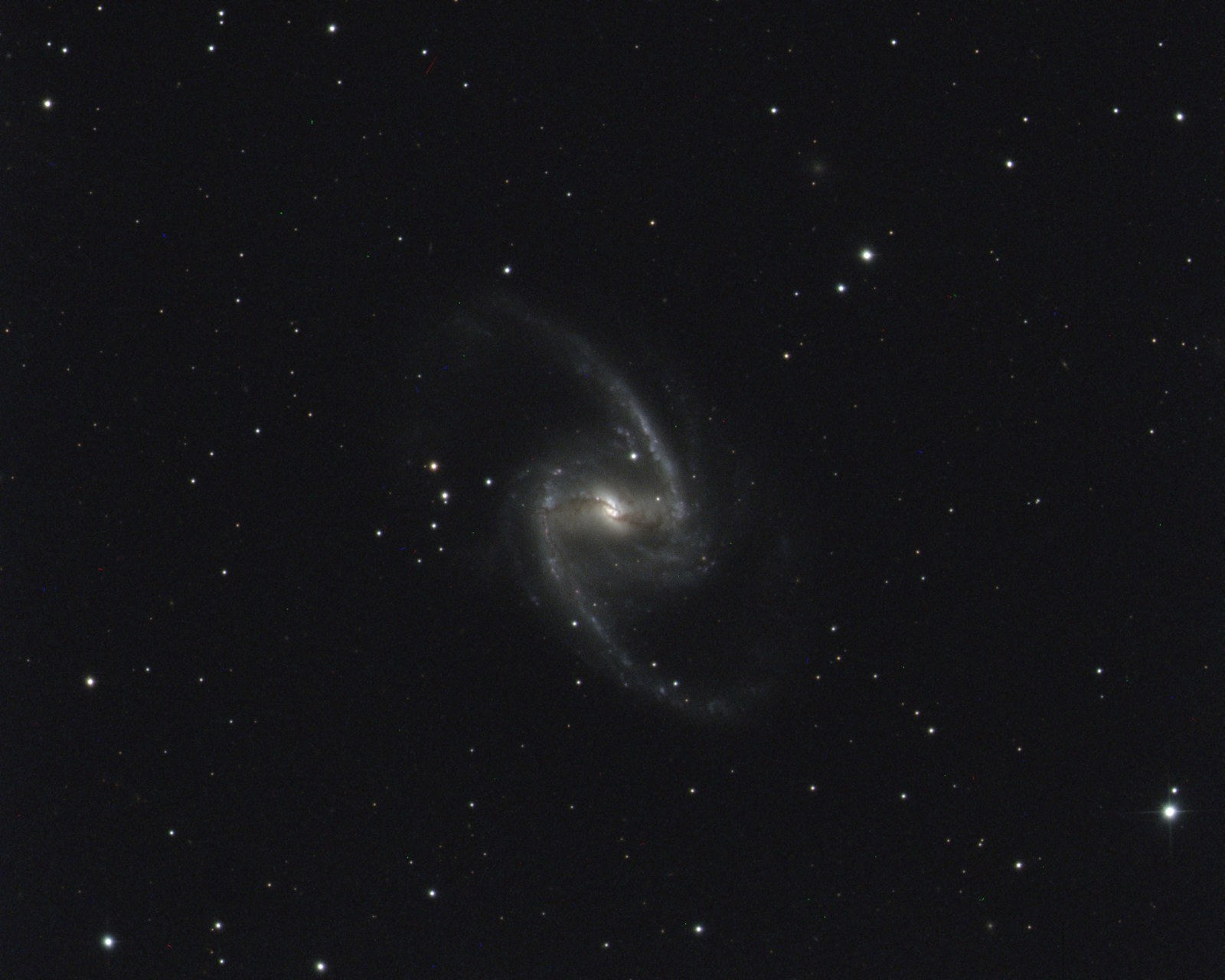
On Thursday, in Every Continent, I wrote that the points were waiting and October was the month. On Saturday I gave in. I could tell you it was for a good reason, that the plan runs in twenty-eight-day cycles and starting now covers Saturn's opposition on the fourth and the new moon on the tenth, and that's true. The real reason is that writing the last piece made me want to look, and once I looked I found three galaxies I had photographed in January 2024 and never developed. So this is what happened when I couldn't wait: the old frames came back, they turned into pictures, and one of them is from Chile.
What was still there
iTelescope keeps your image files on a server for thirty days, longer if there's room. Mine were from January 2024. I logged in expecting nothing and found everything: sixty-eight files, three nights, three telescopes. The Andromeda frame from the night the membership began, which was the top of the last piece. A second Andromeda from later in the month, on a wide fast scope in the same Utah desert. And one I had forgotten: eight frames of a galaxy called NGC 1365, shot through a twenty-inch telescope in the mountains of Chile at three in the morning local time, on the seventh of January, while I slept in Cloverdale.
Every one of them had been sitting there for two years and eight months, calibrated, zipped, waiting. I copied all of it home before anything else. Then I started developing.
Developing
That's the word I've settled on, because it's the closest thing to what really happens. A telescope camera doesn't take a picture. It takes a measurement, one number per pixel per exposure, and gives you the numbers. Nothing in that file looks like a galaxy until you do to it what a darkroom does to a negative: stack the exposures so the faint signal adds up and the noise cancels out, combine the color channels, and then decide how much of the dark to bring up into the light. In 2024 that process defeated me. The software was a wall of sliders, the instructor never quite materialized, and the frames stayed frames.
This time I had Claude beside me, help that doesn't get tired of questions, and I built the darkroom in plain code, one step at a time, so that I could see what each step did to the numbers. The details are in the addendum below for anyone who wants them. The short version is that it took an afternoon, and the first picture that came out is the one at the top of this page.
NGC 1365
It's called the Great Barred Spiral, and it lives in the constellation Fornax, the Furnace, which never rises far above the horizon from California and rides high from Chile. It's about fifty-six million light-years away and roughly twice the width of the Milky Way. The bar is the straight bright stroke through the middle, a river of stars flowing into the core from both sides, and the two arms peel off the ends of it in a long S. The dark line cutting across the nucleus is dust. The blue knots along the arms are places where stars are being born right now, or were, fifty-six million years ago, when this light left.
Sixteen minutes of exposure is thin for a galaxy this faint, and if you look closely the outer arms are soft. I don't mind. It's the first picture I have ever developed from photons that fell on a mirror in another hemisphere, and it's the first thing I'll add to when the Chile telescopes come open again in October.
Andromeda, twice
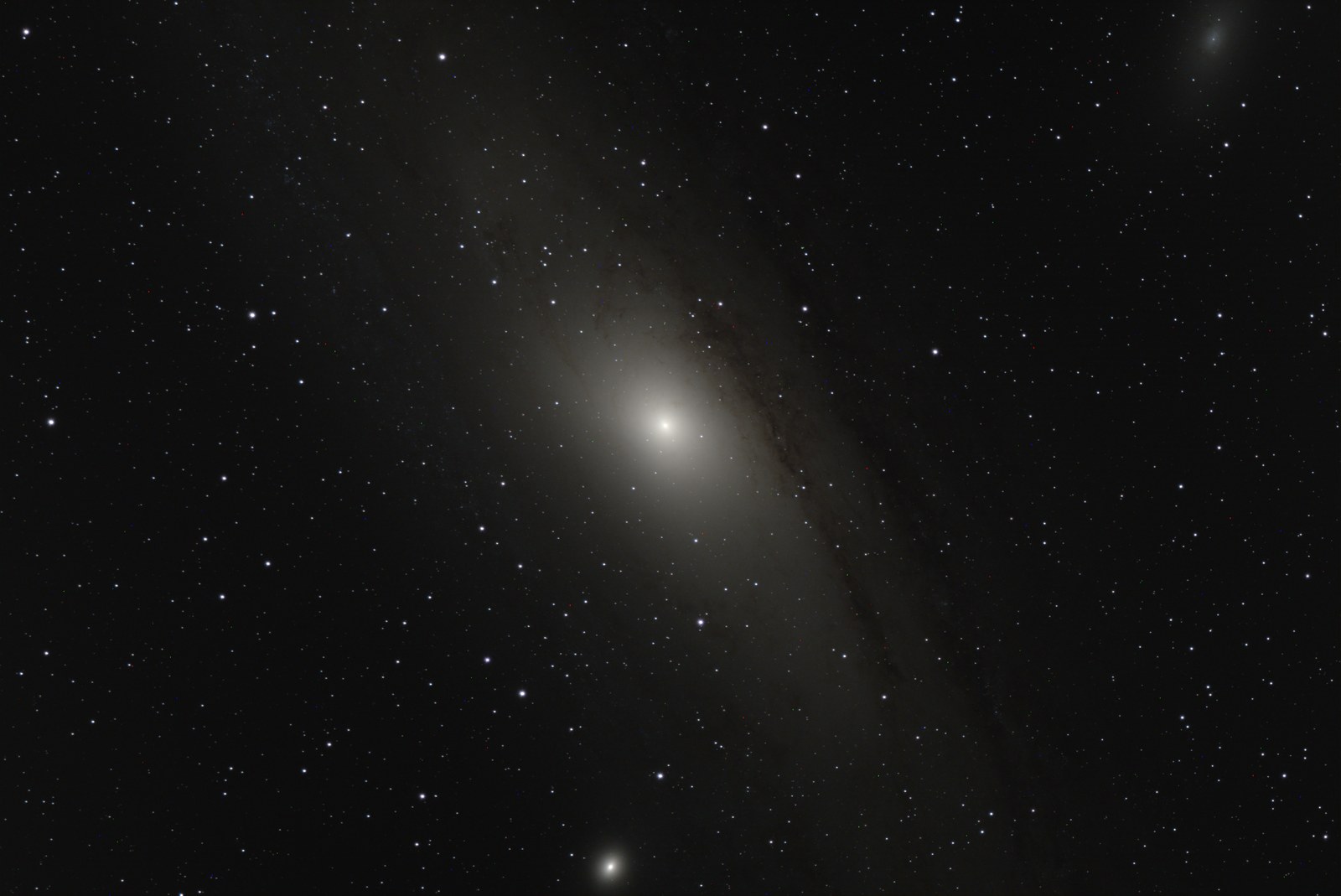
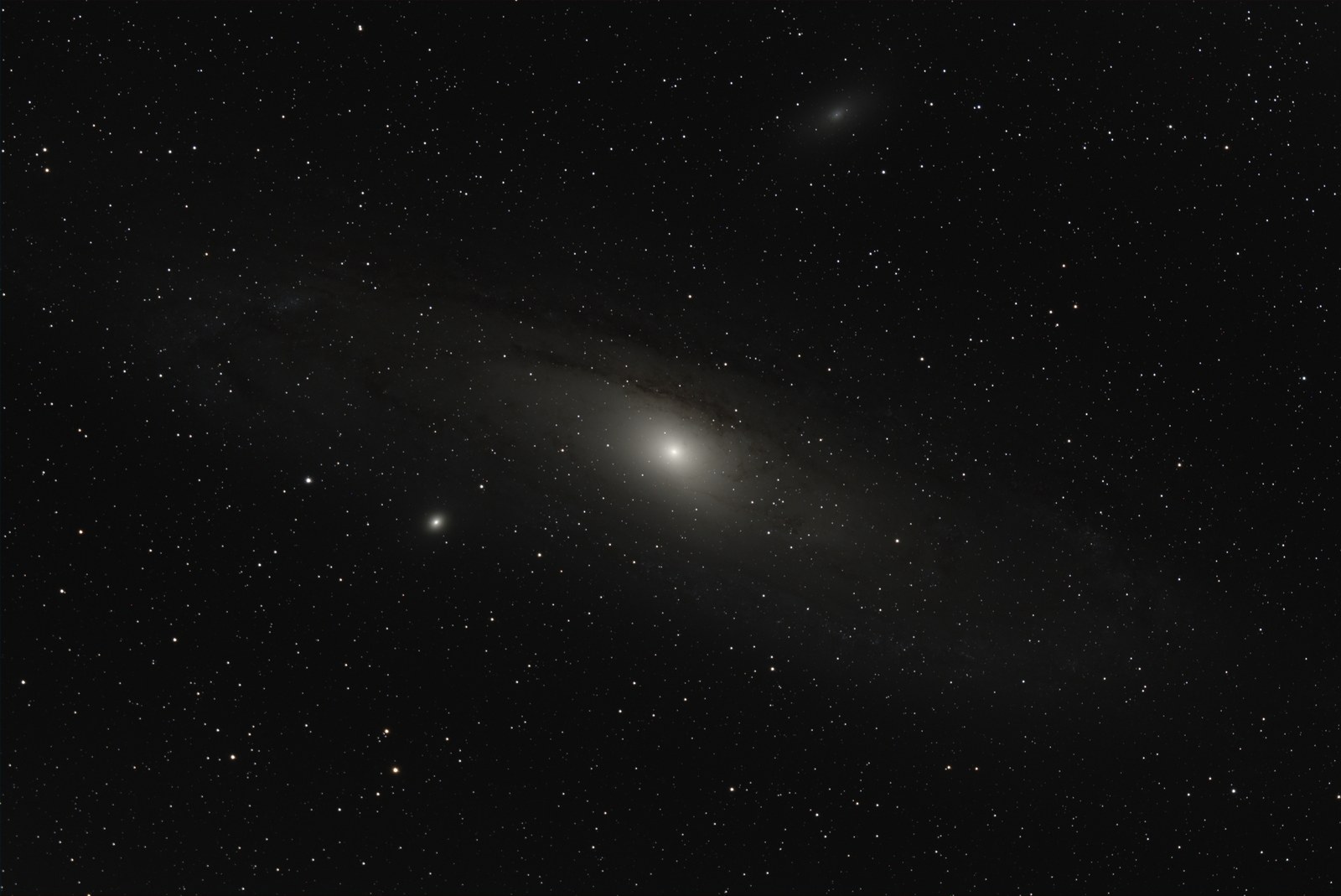
The two Andromeda sets are six minutes each, and they show what a telescope's focal length does. The six-inch refractor from the first night sees the core, tight and bright, with the dust lanes combed through it. The eleven-inch fast scope from later in January sees the whole galaxy at once, arms stretched corner to corner, with M32 tucked below the core and M110 floating above. Same galaxy, same month, same desert, and two different pictures because of one number on the spec sheet. Both are here, the tight one first.
Someone else's two hours
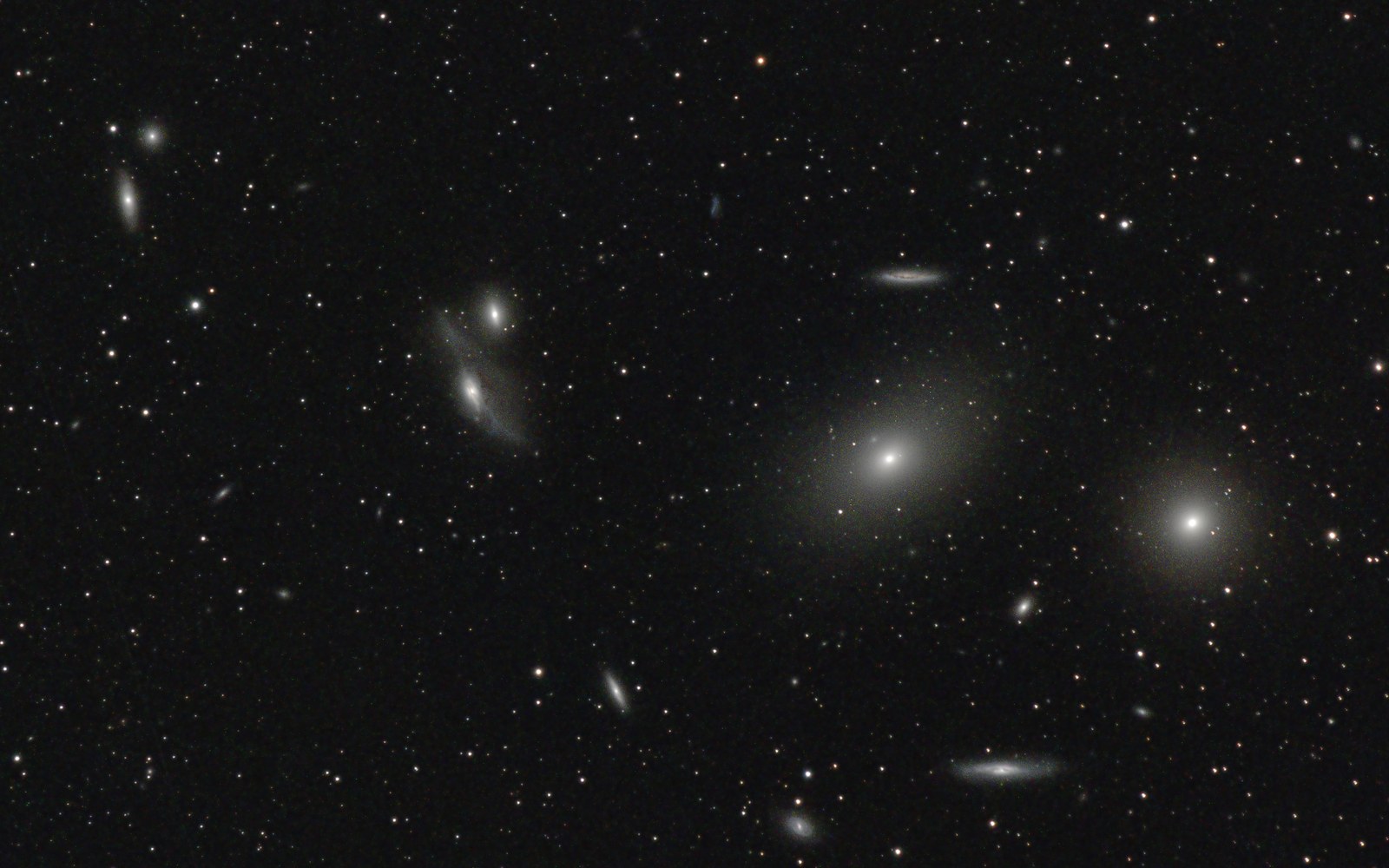
Membership also comes with a monthly gift: a set of raw frames from one of the network's best telescopes, taken by their staff, offered to members to develop. September's set is the heart of the Virgo Cluster, two hours of exposure through a Takahashi refractor in Utah across two nights in April and May. The frame holds two giant elliptical galaxies, M84 and M86, and a pair called The Eyes that are pulling each other apart, and by the network's count more than two hundred galaxies fainter than those. It's some fifty-five million light-years off, and it's the nearest big cluster of galaxies to Earth. It's what a rich neighborhood looks like.
I did not take those photons, so this one is the exception to the exception: a picture I developed but didn't shoot. It's here because it taught me how the process works on data good enough to reward it, and because it's beautiful, and because it turns out that the difference between two hours and sixteen minutes is most of what astrophotography is about.
October, still
The membership is live. The balance is a little bigger than it was. The moon is full this weekend over every one of their sites, which is why nothing new was shot tonight and why the plan still says October. But the frames from 2024 are developed, the darkroom is built, and the next time a shutter opens on Chile the picture will be on this page within the week. I couldn't wait, and it turns out I didn't have to.
Addendum: how the darkroom works
For anyone who wants the numbers. Everything below was done in Python on a laptop, with the astropy, numpy, scipy and photutils libraries, in three short scripts I wrote as I went.
The raw material. iTelescope delivers each exposure as a FITS file, the astronomy standard: a header of keywords (telescope, filter, exposure, temperature, pointing) and then a grid of 32-bit numbers, one per pixel. Theirs arrive already calibrated, which means the camera's own electronic noise (a dark frame) and the optics' uneven illumination (a flat) have been subtracted and divided out. That's a large favor. It's the part beginners most often get wrong.
NGC 1365. Telescope T72 at Deep Sky Chile, latitude 30° south: a 510 mm aperture at 3411 mm focal length, an FLI 16200 CCD binned two by two for a scale of about 1.45 arcseconds per pixel. Eight frames of 120 seconds through separate filters: three red, three green, two blue. No luminance. The frames carry no plate solution, so I aligned them by cross-correlating star masks, which found integer shifts of a few pixels between frames. Each filter's frames were averaged with sigma clipping (any pixel more than 2.5 standard deviations from its siblings across the stack is thrown out, which removed a satellite trail and the cosmic-ray hits). The three stacks became channels: subtract each channel's sky level, scale them so the brightest stars come out white, and combine. Then the sky gradient: a model of the background built on a coarse grid of 150-pixel boxes with the stars and the galaxy masked out, subtracted per channel. It found a blue-heavy vignette running corner to corner. Then about a thousand isolated hot pixels per channel replaced by the median of their neighbors. Then the stretch, an inverse hyperbolic sine curve, which lifts the faint arms a great deal and the bright core only a little, and finally the sky set to a deep grey rather than black.
Andromeda. T02 (150 mm at 1105 mm, 0.70 arcseconds per pixel) and T68 (a 279 mm Rowe-Ackermann astrograph at 635 mm, f/2.2, 1.22 arcseconds per pixel), both in Utah, both one-shot color cameras. iTelescope had already converted each exposure into a three-plane red, green, blue cube, so stacking was: align on the green plane, average each plane with the same sigma clipping. The finishing step is where M31 differs from a small galaxy. It fills so much of the frame that the box-grid sky model mistook the outer disk for sky and ate it. For these I fit a smooth quadratic surface to the sky instead, with a long ellipse masked along the galaxy's axis, and the disk came back. One of the T68 files was truncated on iTelescope's own server; the TIFF copy of the same frame was intact, and the script falls back to it.
Virgo. The September Premium Image Set, Plan-40 tier: a Takahashi TOA-150 refractor at 1100 mm with a ZWO ASI6200MM Pro monochrome camera, 9576 by 6388 pixels, 0.70 arcseconds each, a field of 1.8 by 1.2 degrees. Four frames of 300 seconds in each of luminance, red, green and blue, and four of 600 seconds through a hydrogen-alpha filter: two hours in all, across the nights of April 3 and May 4, 2026. Two things made it harder than it looked. The mount flipped sides of the pier partway through each night, and while the camera rotator kept the sky the right way up, it missed by two tenths of a degree, which is seventeen pixels of misalignment at the frame's edge. I measured the twist from the rotator angle in each header and corrected it before aligning. And one luminance frame correlated weakly against the rest, thin cloud most likely, so it was dropped. The rest went through phase correlation on a four-times-binned copy, a refinement pass at full resolution, and the same clipped averaging. The luminance stack carries the detail; the red, green and blue stacks carry the color; the hydrogen-alpha excess over red was blended into the red channel at about a third strength so the star-forming regions and the gas streaming out of the Seyfert galaxy NGC 4388 show as pink rather than vanishing.
What I didn't do. No star reduction, no deconvolution, no noise reduction beyond a light blur on the sky alone, no color calibration against a star catalog. Those are the next lessons. The point this time was to get from numbers to pictures with every step visible, and to have the darkroom ready before the October light arrives.
Sources: the iTelescope account history and data server, read September 27, 2026; the FITS headers of every frame named above; the Premium Image Set notes published by iTelescope for September 2026. Distances: NGC 1365 about 56 million light-years; the Virgo Cluster core about 55 million. The premium frames were taken by iTelescope staff and remain their copyright; the developed image is published with their standing permission to members.
Related: Every Continent, the gift this all came from.
Elsewhere: iTelescope, The network: Siding Spring, Chile, Spain, Utah.