KSUN · 19.81 · The New Sun · essay ·
Virtuous
Jherek Carnelian, Mrs. Amelia Underwood, and what people who can make anything do with the afternoon.
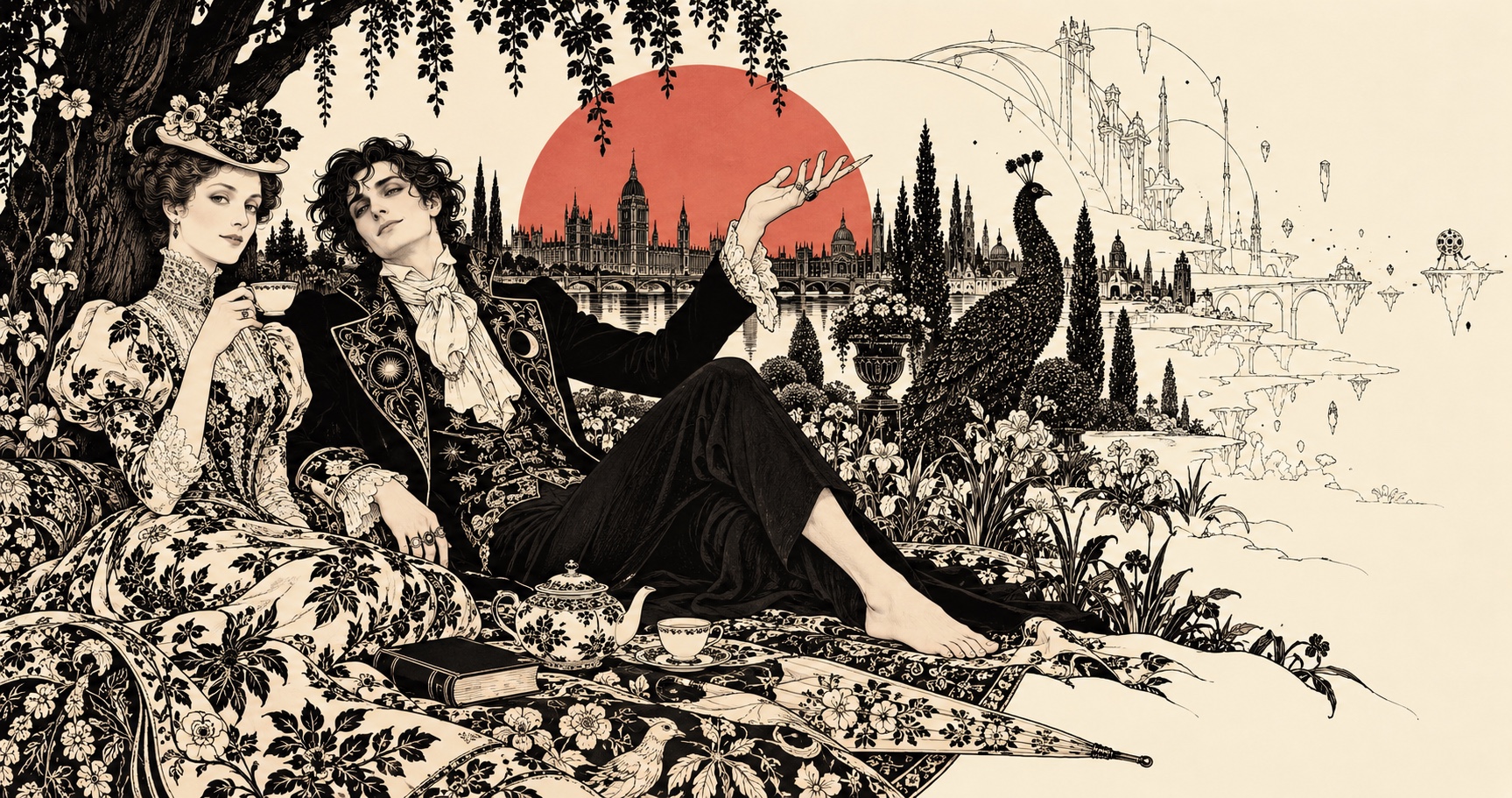
The Dancers at the End of Time is Michael Moorcock's trilogy about the last people on Earth, who can make anything they want by turning a ring, and the one thing none of them can make, which is a reason. It opens with a young man asking his mother what the word "virtuous" means, and neither of them knows. Then a woman from 1896 arrives at a party, and she knows, and the three books are what happens when the two of them try to explain themselves to each other. I read it in 1982, most likely in the Avon paperbacks that had been in American stores since 1977, and it was my first taste of Moorcock's wit, which is sharp enough to cut and warm enough that you don't mind. I've reread it several times since and gone on to nearly everything else he wrote. This is the book I'd hand to anyone with an open mind, some curiosity, and some empathy, and here's why.
The rings
The setting is the far end of the planet's life. The sun is a dim red thing, the universe is winding down, and a few hundred people live on an Earth whose entire surface is their art project. Each of them wears power rings that draw on energy banked by their ancestors in the ancient cities, and a turn of a ring makes a mountain, a lake, a lover, a weather. They are immortal, since death is temporary and your friends will remake you. Nobody works. Nobody needs to. What they do instead is throw parties, stage reconstructions of eras they've half understood from the record, keep menageries of time travellers and aliens who wandered in, and fall into fashions, which sweep the whole society for a season and are then dropped.
That's the idea that caught me in college and still does. Moorcock built a world of beings with godlike power and then asked the real question, which is what you do with the day. The answer, for most of them, is that you entertain each other, because entertainment is the only currency left. And since anything can be made in an instant, the only scarce thing is novelty, which is why Jherek Carnelian matters to them.
Jherek is one of the few people at the End of Time who was born rather than made. He's the son of the Iron Orchid, a woman who treats motherhood as her most daring creation, and he's grown up as the resident expert on the nineteenth century, a period he loves and gets almost entirely wrong. His London is a soup of every era he's read about. When a time traveller named Mrs. Amelia Underwood, of Bromley, Kent, turns up at the Duke of Queens' party on the theme of "disaster," Jherek decides, in the spirit of a new fashion, to fall in love with her. Everyone applauds his originality. Then it stops being a fashion.
Mrs. Underwood
Amelia is the book's Victorian, and the commentary on Victorian morality lives in her. She's married to a dull man named Harold, she sings hymns under stress, she knows her duty and her station, and she has arrived in a world where none of that means anything. What makes Moorcock good at this is that he refuses the easy joke. He could have made her the prude and the End of Timers the free spirits, and plenty of writers in 1972 would have. Instead he lets her be right about things. She has a conscience, and nobody else in the book has one. She can tell the difference between pleasure and happiness, and nobody else can. Jherek, who has no morality at all, is drawn to her because she's made of something he can't make with a ring.
At the same time he lets the decadents be right about things too. Amelia's morality comes with a husband she doesn't love, a God who seems to want her miserable, and a set of rules about what a lady may feel that she's been obeying so long she's forgotten they were rules. The End of Time, for all its emptiness, is a place where she can finally ask herself what she wants. The books work because the exchange runs both ways. Jherek learns what guilt is, and that love means one person rather than everyone. Amelia learns to turn a ring.
The whole thing is dressed in the 1890s, on purpose. The register is Wilde, the drawings in my head are Beardsley, the aesthetes of the End of Time talk the way the Café Royal crowd talked, and the trilogy is a love letter to that decade from a writer who grew up in London and ran a magazine called New Worlds that was, for the 1960s, something like what the Yellow Book had been for the 1890s. H. G. Wells gets a walk-on. Jherek, chasing Amelia back to 1896, is framed for a theft, tried, and hanged, and wakes up at home, because time has a way of spitting out anyone who goes where he shouldn't be.
The company
The other thing I remembered from the first reading, and found again every time, is that every person at the End of Time has a different answer to the question of what to do with eternity, and each one of them is a whole personality built around that answer.
- The Iron Orchid does fashion. She's whatever is newest, and when nothing is new she invents a new self.
- The Duke of Queens does spectacle, on a scale nobody else attempts, with a lack of taste that everyone admires.
- Lord Jagged of Canaria does mystery. He's the dandy who seems to know more than he says, disappears for long stretches, and turns up in other centuries under other names.
- Lord Mongrove does misery. He's a gloomy giant who has chosen melancholy as his art, and he resents being cheered up.
- Werther de Goethe does sin, or tries to. He wants guilt and can't find anything to feel guilty about, which Moorcock turns into a story of his own, "Pale Roses," that is funnier and sadder than it has any right to be.
- My Lady Charlotina does collecting. She lives under a lake and keeps a menagerie of everything that falls through time into her reach.
- Mistress Christia, the Everlasting Concubine, does pleasing people, and is good at it, and is loved for it.
- Bishop Castle does religion as costume, under a mitre ten feet tall.
- Brannart Morphail does science, with a hump and a club foot he wears as credentials, and the law of time travel that throws travellers out of the past is named after him.
- Li Pao is a visitor from a sterner century who disapproves of all of it, and comes to every party.
- Yusharisp is a small round alien who arrives to announce that the universe is ending, and is put in a menagerie.
Even the aliens who turn up to raid the place, the Lat, seven small one-eyed brigands under a Captain Mubbers, have a personality, which is mainly appetite. The point is that a society with no needs produces people who are nothing but character. Each of them has picked a driver and built a self on it, the way you'd build a house, and the trilogy is partly a tour of those houses.
What the reviews reminded me of
I went back and read what other people have said about the books, to see what I'd missed. The novelist Hari Kunzru called the trilogy "one of the great postwar English fantasies," and David Pringle put it in his hundred best science fiction novels in 1985, which is where I'd have put it too. Saxon Bullock's review from 2011 makes the point I'd felt without naming it, that under the culture-clash comedy there's a serious inquiry into what morality is for, and that the romance is real rather than a frame for jokes. He also notes that the third book, The End of All Songs, has less froth than the first two. That's true, and it's where the story earns its ending. The comedy gives way to a man and a woman stranded on a beach in the Palaeozoic, with nothing to turn a ring on, finding out whether they like each other.
Another reviewer, writing at marzaat.com in 2018, pointed out how much of the plot is Lord Jagged's doing. I had remembered Jagged as a charming enigma. On rereading he's the engine of the whole story, a time traveller from closer to our own era who has been arranging Jherek's life, and Amelia's, for reasons that only come out at the end, when the cities are failing and the rings stop working. The reveal of who Jagged is to Jherek is a thing I won't give away here, though the books have been out fifty years.
And one reviewer, Steven H Silver at Black Gate in 2024, reread the books in his sixties after loving them as a teenager and found them hollow, because nothing at the End of Time has consequences and so, he felt, nothing matters. I understand the complaint and I think it's the point. Moorcock built a world without consequences in order to drop a person with consequences into it, and watch what happened. Silver did make me reread the short stories collected as Legends from the End of Time, and he's right that they're where the minor characters get to change, briefly, before the world smooths them over again.
The next sun
The last book ends with the universe coming apart and the question of whether anyone at the End of Time will mind. Some don't. Some, for the first time, do. Jherek and Amelia, who started the trilogy as a joke and a scandal, end it as the two people the whole thing was about, choosing between a loop where nothing ever changes and a door into something they can't see. Amelia, who believes a life without duty is useless, chooses the door. It's a love story, maybe the last one, told in a world that had forgotten what love was for, and the people who come out of it have been changed by someone from a century that couldn't have imagined them.
Moorcock has written a great deal, and I've read nearly all of it. Elric, the doomed albino with the soul-eating sword, is the series most people meet first, and I loved it, and it needs its own post. This is the one I'd start with. It's short, it's funny, it has a heart, and it asks what you would do if you could do anything, and whether the answer would be worth doing. If you've got an open mind, some curiosity, and some empathy for people who are nothing like you, you'll like these people, and they'll like you back.
Sources: Michael Moorcock, An Alien Heat (1972), The Hollow Lands (1974), and The End of All Songs (1976), collected as The Dancers at the End of Time (Granada, 1981); Legends from the End of Time (1976). US paperbacks from Avon, 1977 and 1978. Reviews consulted: Saxon Bullock, February 7, 2011; marzaat.com, February 26, 2018; Steven H Silver, "The End of Time and Me," Black Gate, September 11, 2024. David Pringle, Science Fiction: The 100 Best Novels (1985).
Related: Kansas, another stranger learning the rules of somebody else's world.