KOBS · 20.22 · The Observatory · essay ·
Last Call
The free week closed this morning. Before last call: a star that blew itself apart in the Veil, a star being born in the Eagle, and the same three colors running through both.
The free week ended this morning while I was pouring coffee. I sat down to point a telescope in Australia at the Helix Nebula, and the red banner across the top of the page had changed overnight. The Moon had slipped below seventy-five percent, and happy hour was over. I'd missed last call by a few hours. The Helix plan is saved on the telescope and will keep until the next full moon. Elsewhere on this site there's a radio host whose bicycle tire got stolen on the way to work, and what she did about it is still my model: look at it, accept it, wish it well, and get to the studio. So here's the studio.
The Veil
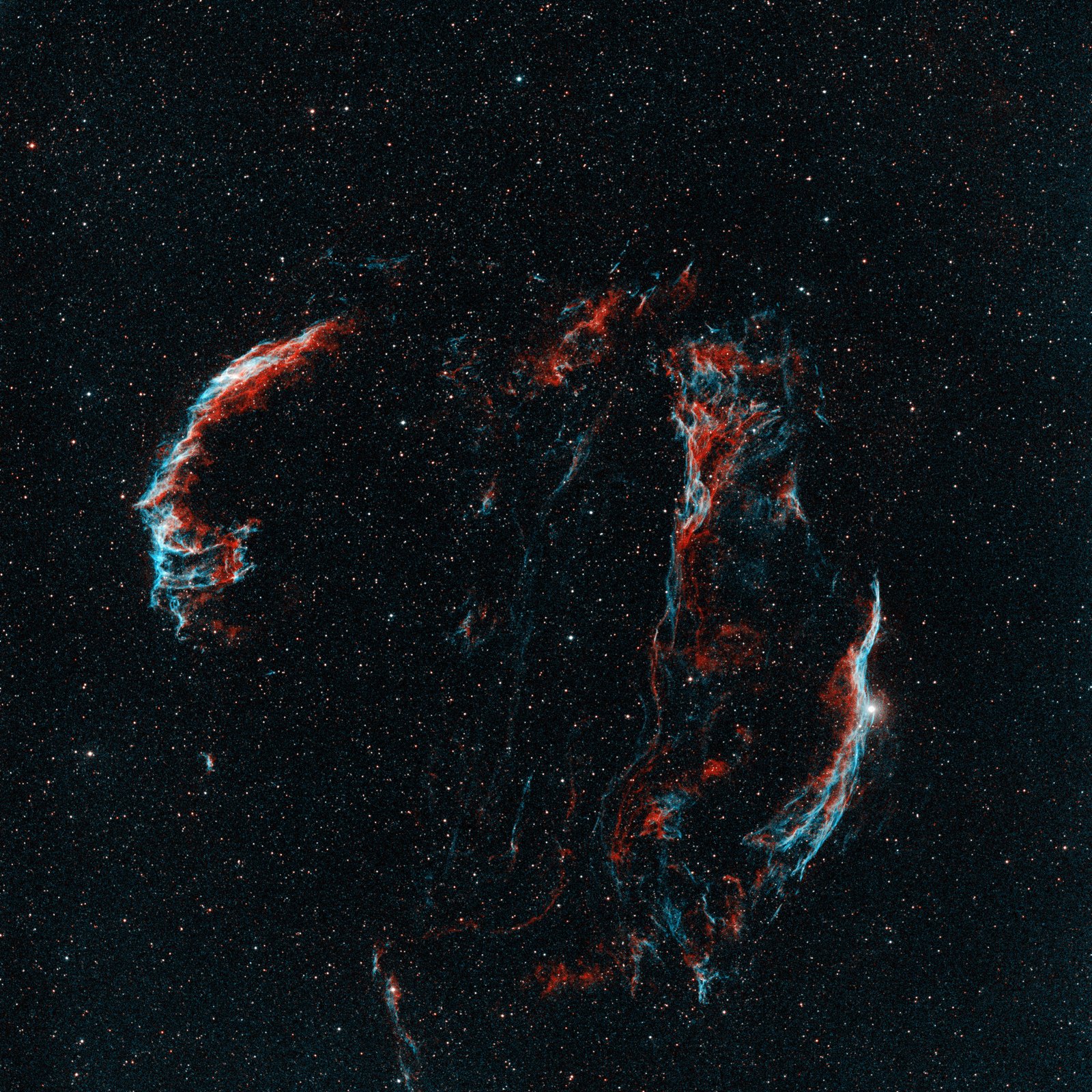
Last call, the night before, went to the Veil Nebula, on a small, wide telescope in the Utah desert, a four-inch refractor that sees a patch of sky four degrees across, eight full Moons side by side. Most telescopes on the network see a corner of the Veil. This one sees all of it.
About ten to twenty thousand years ago, a star many times heavier than the Sun ran out of fuel, collapsed, and exploded. The blast is still going. It has swept outward into a bubble about 120 light-years across, and where it runs into the thin gas between the stars, the shock heats that gas until it glows. The Veil is the glow.
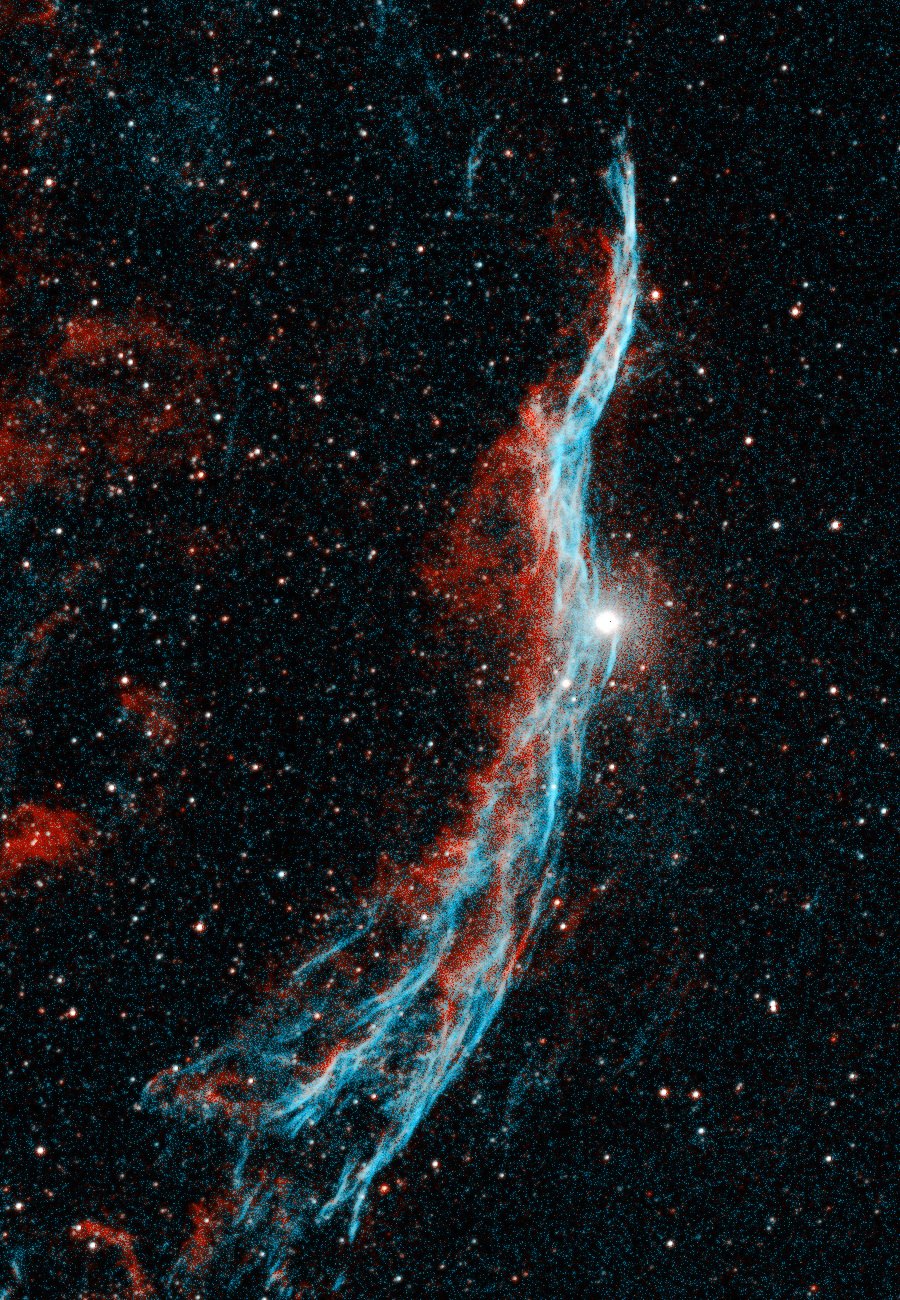
It looks like curtains hanging in space, and that's an effect of looking at a bubble. A soap bubble is brightest at its edges, where you're looking along the skin of it. The bright arcs are the rim of the Veil seen edge-on, and the faint middle is where I'm looking straight through the thin front and back. It's about as deep as it is wide. Astronomers pinned down its distance, about 2,400 light-years, by checking which stars show its gas in their light and which don't: the ones behind it do, the ones in front don't.
William Herschel found it in 1784. The arc on the left is the Eastern Veil. The tangle at the top middle is Pickering's Triangle, which Williamina Fleming found on Harvard's photographic plates in 1904 and which was named for her boss. The sweep on the right is the Western Veil, which people call the Witch's Broom, and the bright star it runs past, 52 Cygni, is much closer to Earth and has nothing to do with it.
The Eagle
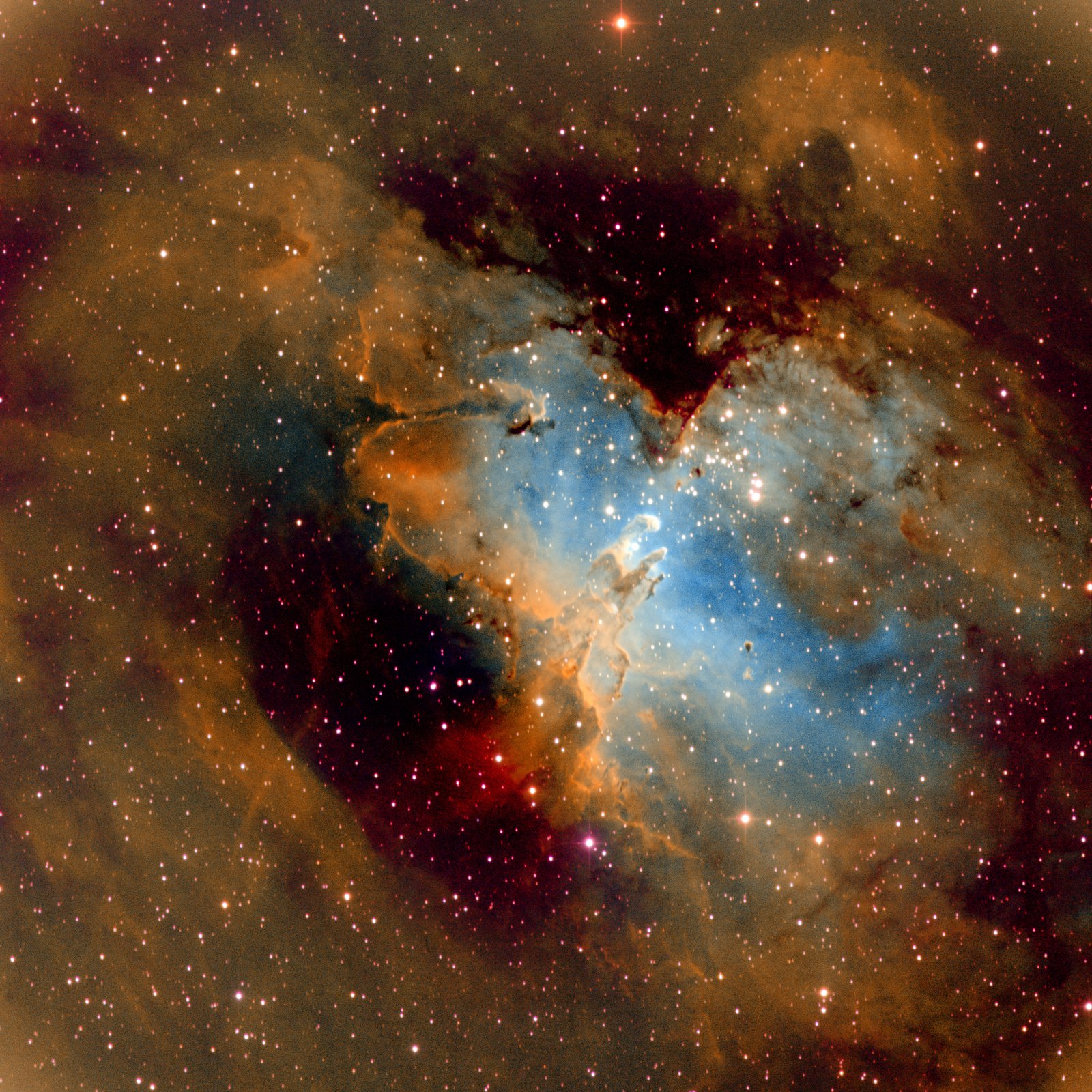
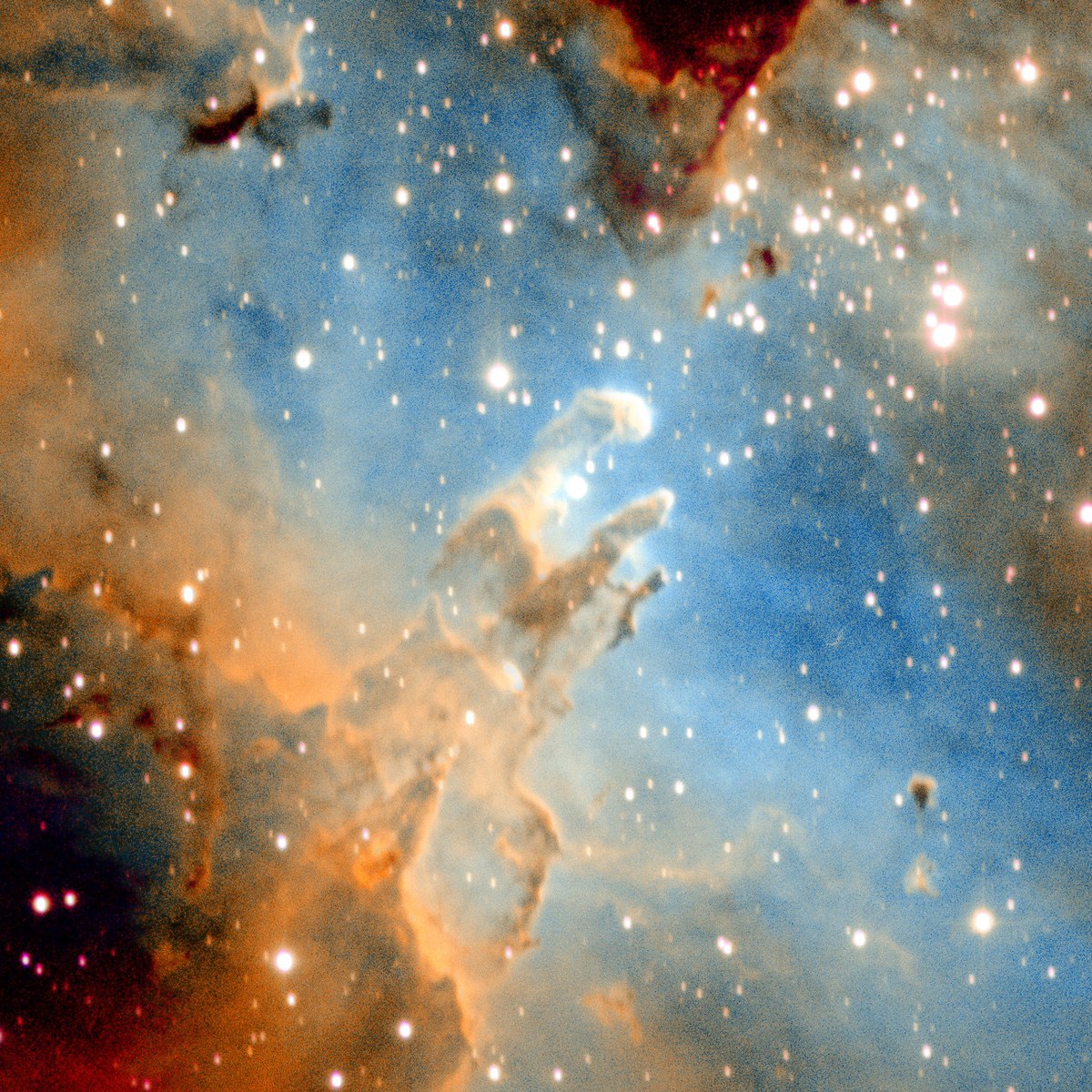
The other picture is October's gift from iTelescope, seven hours of exposure from one of their telescopes, taken by their staff, which I developed but didn't shoot. It's the Eagle Nebula, about 7,000 light-years away in Serpens, and at its heart are the three dark columns Hubble made famous in 1995 as the Pillars of Creation.
The Eagle is the other end of the story. It's a cloud of gas and dust where stars are being born. The young stars already there are fierce and hot, and their light is boiling the cloud away. The pillars are the parts dense enough to hold out for now, and inside their tips, where the gas is squeezed hardest, more stars are forming.
I made it in the Hubble palette, where sulfur is red, hydrogen is green and oxygen is blue, each stretched on its own. Gold is where hydrogen and sulfur glow together, and blue is the oxygen in the hot hollow the young stars have carved out.
Three of a kind
Put the three from this week side by side and they make a set. The Eagle is a nursery. The Dumbbell, from the last post, is how a star like the Sun dies, quietly, puffing off its outer layers. The Veil is how a heavy star dies, all at once.
And they're shot in the same three colors, because every one of them glows the same way: hydrogen red, oxygen blue, sulfur gold. Those colors are a map of chemistry, and the chemistry is what connects them. Supernovas like the one that made the Veil are where much of the universe's oxygen is made, and their blast waves spread what the star made, and stir everything they sweep through, into the clouds where the next stars form. Some cloud like the Eagle, five billion years ago, made the Sun and the Earth out of material like that. The oxygen I'm breathing while I write this went through it.
What it cost
Nothing, again. The Eagle came with the membership. The Veil made last call, and the run log said so: "You will not be billed for this session." The Helix will wait. The next happy hour starts around October 21.
Addendum: how the pictures were made
For anyone who wants the numbers. Python on a laptop, astropy, numpy, scipy and photutils, and the same short scripts as the last two posts, each a little better.
The Veil. Telescope T14, Utah Desert Remote Observatory: a Takahashi FSQ-106 refractor, 106 mm aperture at 530 mm, with an SBIG STX-16803 CCD, 4096 by 4096 pixels of 9 µm, 3.5 arcseconds per pixel, a field of 3.98 degrees square. Four 300-second frames through hydrogen-alpha and four through oxygen-III, dithered, from 8:37 to 9:25 pm Mountain time on September 30, before the Moon rose. The run log measured the true focal length at 532 mm and plate-solved on 146 stars. The star matcher from the last post now fits a full affine transform for each frame, shift and rotation together, starting from a voted translation and refining with matched pairs within 6, 3 and then 1.5 pixels. All eight frames landed within 0.05 pixels, and the hydrogen and oxygen sets showed no rotation between them, which is what one night on one mount should look like. The finish is the same two-filter palette as the Dumbbell: hydrogen to red, oxygen to blue, green from four parts oxygen and one part hydrogen. Cygnus sits in the Milky Way, and the frame holds tens of thousands of stars, so this time there's a star-reduction step: wherever a pixel stands well above the median of its 7-pixel neighborhood, it's pulled most of the way back toward that median. Filaments are wider than stars and survive it; most of the small stars shrink. The first version had corners that looked worn, a little lighter and grainier than the middle. I thought it might be light leaking in. The sky level in the corners matched the center to within a couple of percent, but the noise in the oxygen channel was up to 26 percent higher there. A wide refractor on a big square sensor gets a little less light into its corners, the calibration flat brightens them back up, and it brightens their noise along with them. With one black point for the whole frame, more of that noise poked through in the corners. Now the black point follows a map of the local noise, and the sky model has two extra terms for the falloff toward the corners.
The Eagle. The October 2026 Premium Image Set, Plan-40 tier: four 300-second frames in each of red, green and blue, and four 1,800-second frames in each of hydrogen-alpha, oxygen-III and sulfur-II, 4096 by 4096 pixels. The headers carry only the filter, exposure and gain, so the frames were aligned on stars. The filters came from different nights, and the affine fit found the color set rotated 0.40 degrees from the hydrogen set, the oxygen set 0.34 degrees, and one sulfur frame 0.56 degrees, all lined up to a fraction of a pixel. The corners had a ring of uneven brightness that the gentle curved sky model from earlier posts couldn't follow, so the model gained two radial terms and now throws out tiles sitting on the nebula before it fits. The Hubble version maps sulfur, hydrogen and oxygen to red, green and blue, stretches each on its own, pulls green down toward the average of the other two, and lifts red where it beats blue for the gold.
Sources: the T14 run log for September 30, 2026; the FITS headers of every frame; iTelescope's release notes for the October 2026 Premium Image Set. Distances: the Veil about 2,400 light-years; the Eagle about 7,000. The Eagle frames were taken by iTelescope and remain their copyright; the developed images are published with their standing permission to members.
Related: On the House, the Dumbbell and the Sculptor; For Headphones Only, for the studio.
Elsewhere: iTelescope, The network: Siding Spring, Chile, Spain, Utah.