KFHO · 19.76 · For Headphones Only · essay ·
For Headphones Only
A Sunday-night radio show from Minneapolis, remembered, and two new ones made in its shape.
On Sunday nights in Minneapolis, at ten, a woman on KQRS played long songs for people wearing headphones. That was the whole format. The show was called For Headphones Only, and the name was an instruction. You were meant to be lying down, in the dark, with the cans on, and the music was chosen for what it would do in that position: the long instrumentals, the early synthesizers, the prog records that took a side of vinyl to say one thing. Tangerine Dream. Genesis. The Moody Blues. Anything that unfolded. This is about that show, what it did to a seventeen-year-old in the dark, and the two shows I have made in its shape.
I was seventeen. I did what the name said, and I kept doing it for at least three years, into college, with a cassette deck running. I would listen to the tape all week, between classes, and then on Sunday I would tape over it, because tapes cost money and the next show was always better than the last one.
I don't remember her name, and I have looked. What I remember is that she was a hippie in the best sense, cool and sweet at the same time, and that she knew prog rock all the way down and had fallen just as hard for the new electronic music that was arriving from England. She played me most of it first. Depeche Mode's first album went straight into my headphones the week it was released, before anyone I knew in America had heard of them. I remember, too, that one week she came on five minutes late because somebody had stolen the tire off her bicycle and she'd had to find another way to the studio. She told us about it, and then she said that whoever took it must have needed it, and she hoped it got them where they were going. I have carried that around for forty-some years. It is still my model for meeting what happens: look at it, accept it, wish it well, and get to the studio.
What the show taught
The songs were good. What stayed was a way of listening.
The show worked in threes, mostly. She would introduce a song, play it, mix into two more, sometimes three, and then come back and talk about the ones you had just heard. So you were always listening forward, with an ear on what she'd say afterward, and you were never allowed to skip. There was no next button. There was a woman in a room downtown deciding what came next, and for two hours you let her. The result was a journey rather than a collection, and once you have heard music that way you cannot entirely go back to hearing it the other way.
Everything I have listened to since has been sorted by that rule. Stereolab, Röyksopp, Air, Philip Glass, Eno, the French house records, the Balearic ones: every one of them earns its place by unfolding. When I finally sat down, decades later, to say what my own version of the show would have to be, the rules came out in one breath:
- Every pick traces back to the progressive lineage.
- Electronic and minimal are welcome.
- Any song can be an instrumental.
- Let the set unfold.
- Immersion, not nostalgia.
I have written elsewhere on this site about music as a way of rehearsing a state until the state is yours. This was where I learned it, on Sunday nights with the lights off, before I had the words.
Two shows
So here are two. Rather than recreating the show, I kept its shape and put the music I would choose now inside it. Nobody is going to mistake a mix on Mixcloud for a transmitter on a hill.
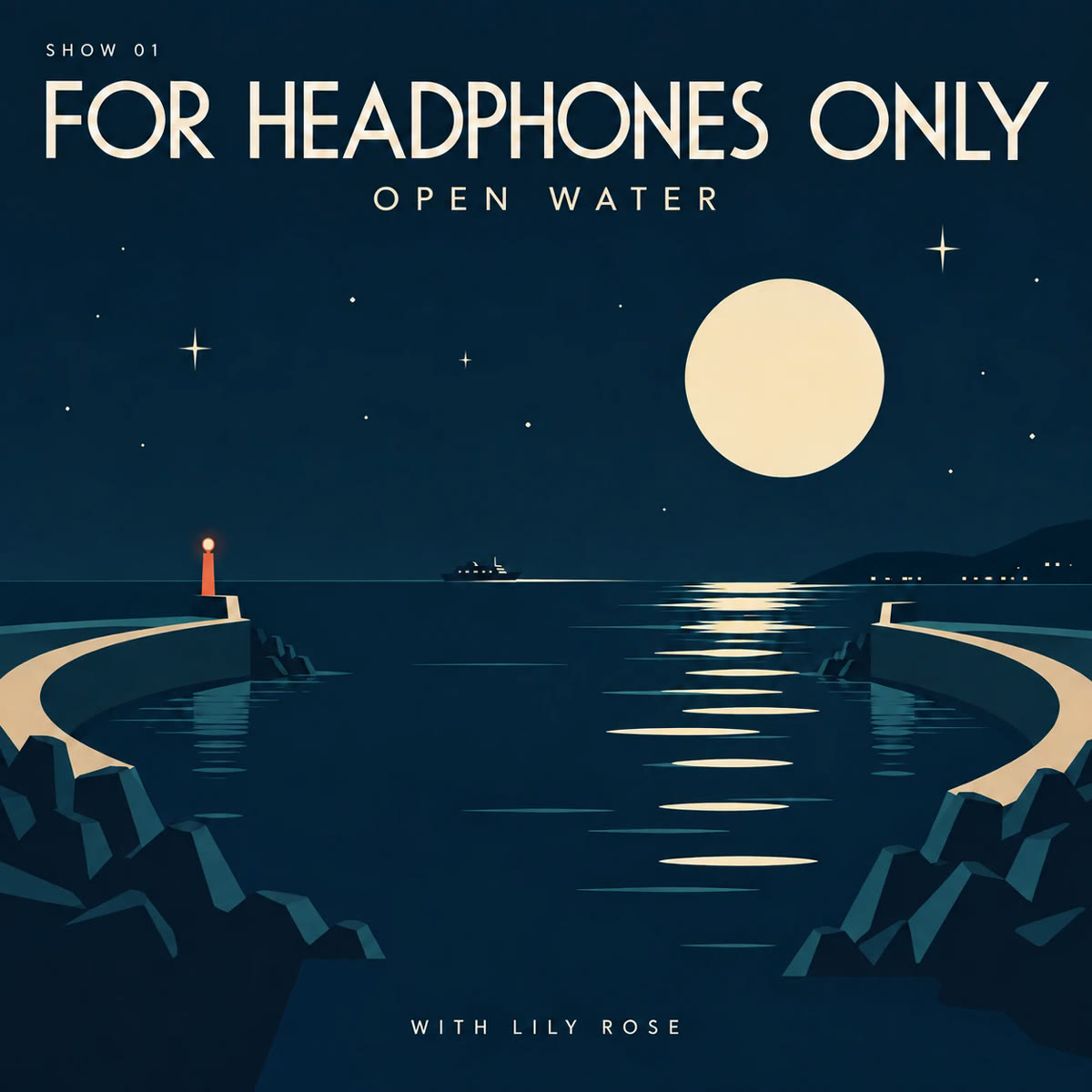
Show 1: Open Water. A day that ends at sea. It opens with Greg Lake and an acoustic guitar and moves through the machines waking up, the city after midnight, an elegy, the long way out of orbit, and open water. King Crimson takes it out past the breakwater.
Show 2: Five Past Ten. One Sunday, morning to night. It opens with the Moody Blues arguing with a computer about whether you exist. I heard that argument at seventeen with the headphones on, and it may be the first time the question got into me. I have been chasing it ever since, through a philosophy degree, a thesis on whether a machine could have a mind, and most of what is on this site. Then the show goes out for the day: a bicycle race, a morning, a long afternoon, a night at the pictures, and a last set that ends on Biko and the quiet after it.
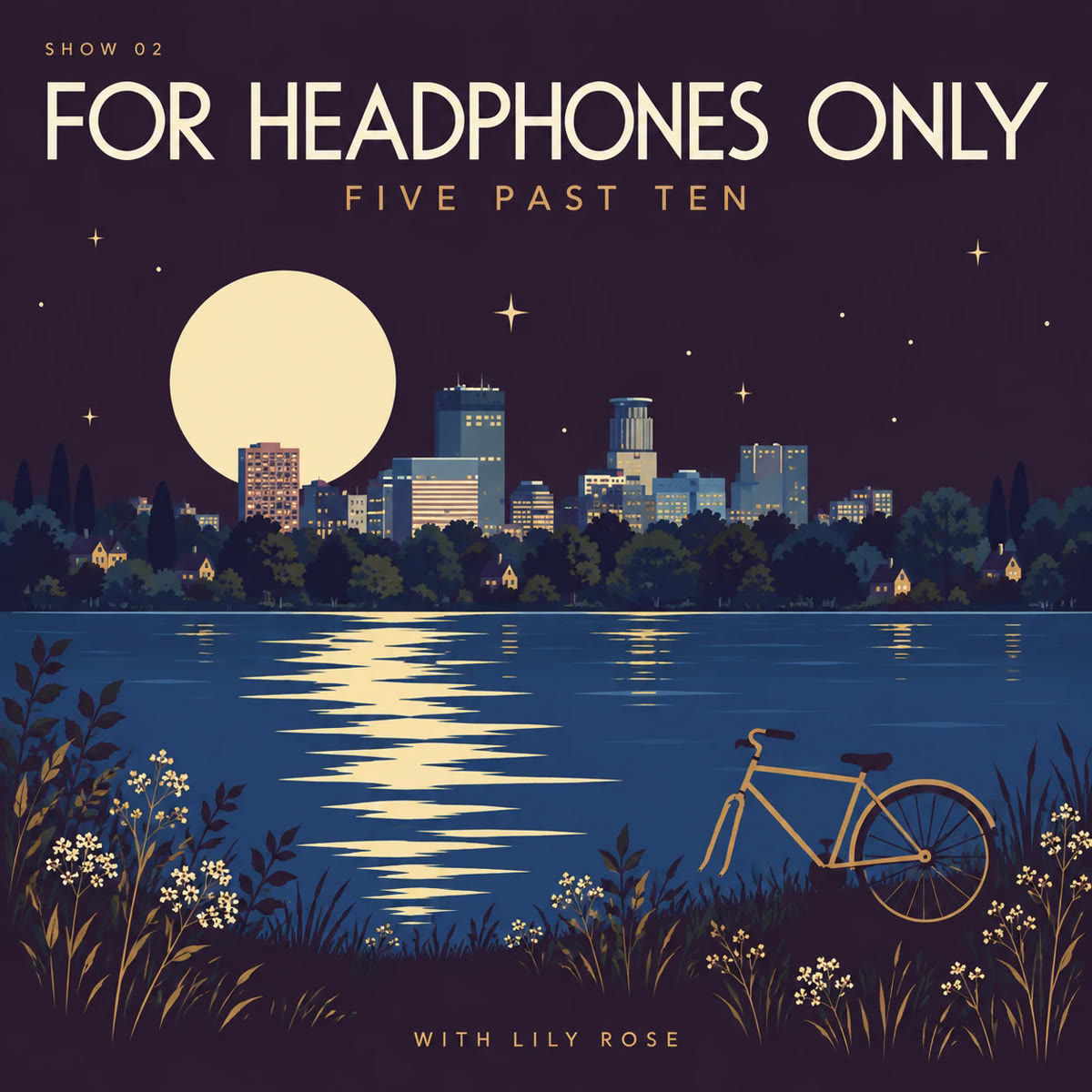
There is a host. She introduces the first song of each set, comes back afterward to say a word about the others, and hands off to the next. She is late for Show 2, because somebody stole the tire off her bicycle, and she says what the original said. Her name is Lily Rose and she is not a person. She is a voice made by a machine, reading words I wrote for the woman I couldn't name, and I would rather tell you that than have you wonder. The real one was real. This one is a way of keeping her.
How they hold together
The first thing you notice about the set lists is the spread. Ken Nordine alone in space in 1957, with nothing under his voice but the sound of space. The Moody Blues in 1969. Kraftwerk in 1978 and again in 2003. Depeche Mode barely twenty. Portishead in the rain. Beach House in 2022. Fifty years of records that would not be shelved together in any store, and none of them sounds out of place next to the others, because they were chosen for the same reason. Every one of them takes its time. Every one of them makes a space and lets you into it. That was her rule, whether she ever said it out loud, and it turns out to be a stronger organizing principle than genre or decade. Put a room-maker next to a room-maker and the rooms connect.
The second thing is the pacing, which is the part the format does for you. Three or four songs, then a voice, then three or four more. The voice is there so you can come up for air, find out where you are, and go back under. The talk is always shorter than the music, by a mile, and by the end of the night she is saying almost nothing: the names, and good night. That is on purpose. By then you don't need her.
Inside each set the songs hand something to each other. Greg Lake's acoustic guitar gives way to Peter Gabriel's flood, and the flood gives way to King Crimson asking you, in Japanese, to please wait, and Radiohead showing you what happens if you do. The Alan Parsons Project's robot wakes up and Kraftwerk's city is already running, and then four boys from Basildon are learning that a synthesizer can be shy. Elegia is an instrumental written for a dead friend, and the three songs after it are three different ways of holding on to something. Ken Nordine is alone in orbit and a little in love with the view, and Supertramp takes him the rest of the way out. The last set is water: an exorcism with a groove under it, a narrow way, and eight minutes of King Crimson that feel like the horizon.
The second show is a day, and it moves the way a day does. It wakes up slowly, the Moody Blues and Genesis and Greg Lake at his gentlest. It goes out on the bicycle, three versions of the same Kraftwerk song, which sounds like a joke until you hear how a song can change its mind. Then the morning proper: Kate Bush's fog lifting, a song by Andy Bell and Masal that came out this month, because she always played what was new, and a meadow in Grantchester where a fly does not make it to the end of the song. The light goes long: Tuesday Afternoon, a death in the afternoon, a dream about it, and a diary to write it down in. Then it is dark and you are at the movies, ten minutes of Saint Etienne that go by in four and twelve minutes of Jon and Vangelis pretending to be Bogart. And then the last set does the thing she always did, which is get serious right at the end. Leave in Silence. Biko. And OMD's title track to walk you home, wordless.
What the two shows have in common, and what they have in common with hers, is that they are trips. Not background, not a mood to put on while you do something else. You are lying down with the headphones on and you are going somewhere, and the pleasure of it is the same pleasure as a road you have never driven at night: you don't know the next bend, and you don't have to. Somebody else is choosing. For two hours, that is the whole of the ride, and it is the best part.
Set lists
Show 1: Open Water
- Emerson, Lake & Palmer - From the Beginning
- Peter Gabriel - Here Comes the Flood
- King Crimson - Matte Kudasai
- Radiohead - Everything In Its Right Place
- The Alan Parsons Project - I Robot
- Kraftwerk - Metropolis
- Depeche Mode - Any Second Now (Voices)
- Depeche Mode - Monument
- Portishead - Theme from 'To Kill A Dead Man'
- Massive Attack - Teardrop
- Orchestral Manoeuvres In the Dark - Veruschka
- Brian Eno - The Big Ship
- New Order - Elegia
- Beach House - Over and Over
- M83 - We Own the Sky
- Simple Minds - Somebody Up There Likes You
- Ken Nordine - Manned Satellite
- Supertramp - Fool's Overture
- Tangerine Dream - Chronozon
- Brian Eno & David Byrne - The Jezebel Spirit
- Pink Floyd - The Narrow Way, Pt. 1
- King Crimson - The Sheltering Sky
Show 2: Five Past Ten
- The Moody Blues - In the Beginning
- Genesis - Your Own Special Way
- Emerson, Lake & Palmer - Still...You Turn Me On
- Kraftwerk - Tour de France 2003 (Version 1)
- Kraftwerk - Tour de France 2003 (Version 2)
- Kraftwerk - Tour de France 2003 (Version 3)
- Kate Bush - The Morning Fog
- Andy Bell & Masal - The Morning of the Trip
- Pink Floyd - Grantchester Meadows
- The Moody Blues - Tuesday Afternoon
- Ultravox - I Remember (Death In the Afternoon)
- The Alan Parsons Project - A Dream Within a Dream
- The Moody Blues - Dear Diary
- Saint Etienne - Cool Kids of Death (Underworld Mix)
- Jon & Vangelis - The Friends of Mr. Cairo
- Depeche Mode - Leave in Silence
- Peter Gabriel - Biko
- Orchestral Manoeuvres In the Dark - Architecture and Morality
Both shows are on Mixcloud, where the tracklists follow the players: Open Water and Five Past Ten.
Related: Song as Sigil, where the rehearsal idea lives; The Machine Question, for what a seventeen-year-old with headphones on carried into a philosophy degree.
Elsewhere: For Headphones Only 01: Open Water on Mixcloud, the first show. The second, Five Past Ten, is on Mixcloud too.