KOBS · 20.22 · The Observatory · essay ·
On the House
When the Moon is too bright for the paying customers, the observatory buys a round. I took two, a dying star in California and a starburst galaxy in Australia, and I didn't spend a single point.
In the last post, Saturn cost me thirty-seven points, about the price of a nice lunch. This week lunch was on the house. Twice.
Happy hour
Around every full moon, iTelescope runs something it calls Full Moon Happy Hour. A red banner goes up across the top of every telescope page, and for about a week any member can take one telescope for one hour of live imaging each night and pay nothing at all. The reason is the Moon. A bright Moon floods the sky with light, the people hunting faint galaxies stay home, and the telescopes would otherwise sit idle on their mountains. So the network gives them away, an hour at a time, first come, first served.
It turns out a lot of people have the same idea.
The race
With the observatory in Chile closed for power upgrades and every roof in Utah shut, the only telescope open in my evenings was T24, a twenty-four-inch at the Sierra Remote Observatory, up in the foothills east of Fresno. On Monday night I lost it twice. On Tuesday I lost it again at nine-thirty, and then at 11:06 it came free and another member got to it about ten seconds before I did. Each telescope page has a small button marked Hold, which claims the scope for a few minutes while you set up. They pressed it first. Ten seconds.
So I changed tactics. The last paid booking of the evening ended around a quarter to one, and by then most of the competition would be in bed. I set everything up to claim the telescope the moment it opened, and I went to bed too. At 12:46 it opened, the Hold went in, and my plan started while I was asleep.
There was one more lesson waiting. My list for the hour had four things on it, one after another. The first one ran for twenty-seven minutes, and the instant it finished, the telescope logged me out. Another member had it within a minute. The globular cluster, Neptune and its moon Triton, and the Moon itself never ran. Happy hour has a bouncer, and he doesn't save your seat. Next time the whole order goes in at once.
The Dumbbell
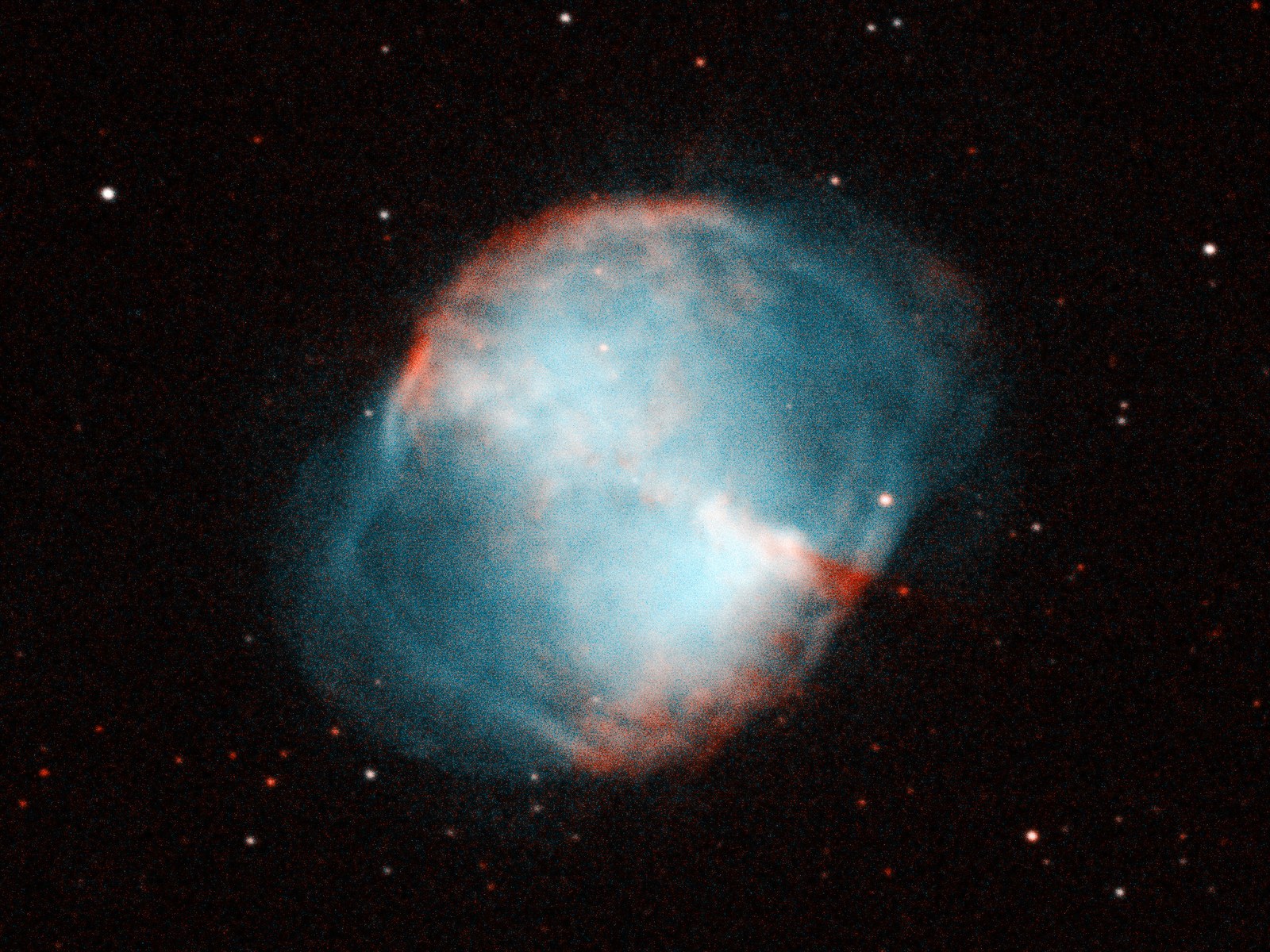
What I did get was sixteen minutes on M27, the Dumbbell Nebula, about 1,300 light-years away in the little constellation Vulpecula, the Fox. It was the first object of its kind anyone ever found. Charles Messier logged it in 1764.
It's called a planetary nebula, which is an old and misleading name. It has nothing to do with planets. It's what's left when a star like the Sun runs out of fuel and puffs its outer layers into space, and it's what the Sun will do in about five billion years. The star that made this one shed its shell roughly ten thousand years ago, and what's left of it is the faint point near the middle, now a white dwarf about the size of Earth, still hot enough to make the gas around it glow.
I shot it through two filters that each pass the light of a single gas, which also shuts out most of the moonlight. Hydrogen is red and oxygen is teal. The bright hourglass is where the gas is thickest, and the pale shell around it, the part that fills in the "dumbbell" and makes it look more like an apple, came through even with the Moon eighty-four percent full.
Coffee in Australia
On Wednesday morning I was having coffee when I noticed that the telescopes at Siding Spring Observatory in New South Wales were all open, and the red banner was up. My morning is their midnight. I opened all five of them, and within a minute two had been claimed by other members. I took T30, a twenty-inch, and this time I followed my own advice: one target, filling the whole hour, so there'd be no gap for anyone to slip into.
A few minutes later the run log said the thing I'd been hoping to read all week: "You will not be billed for this session." I read it twice.
The Sculptor Galaxy
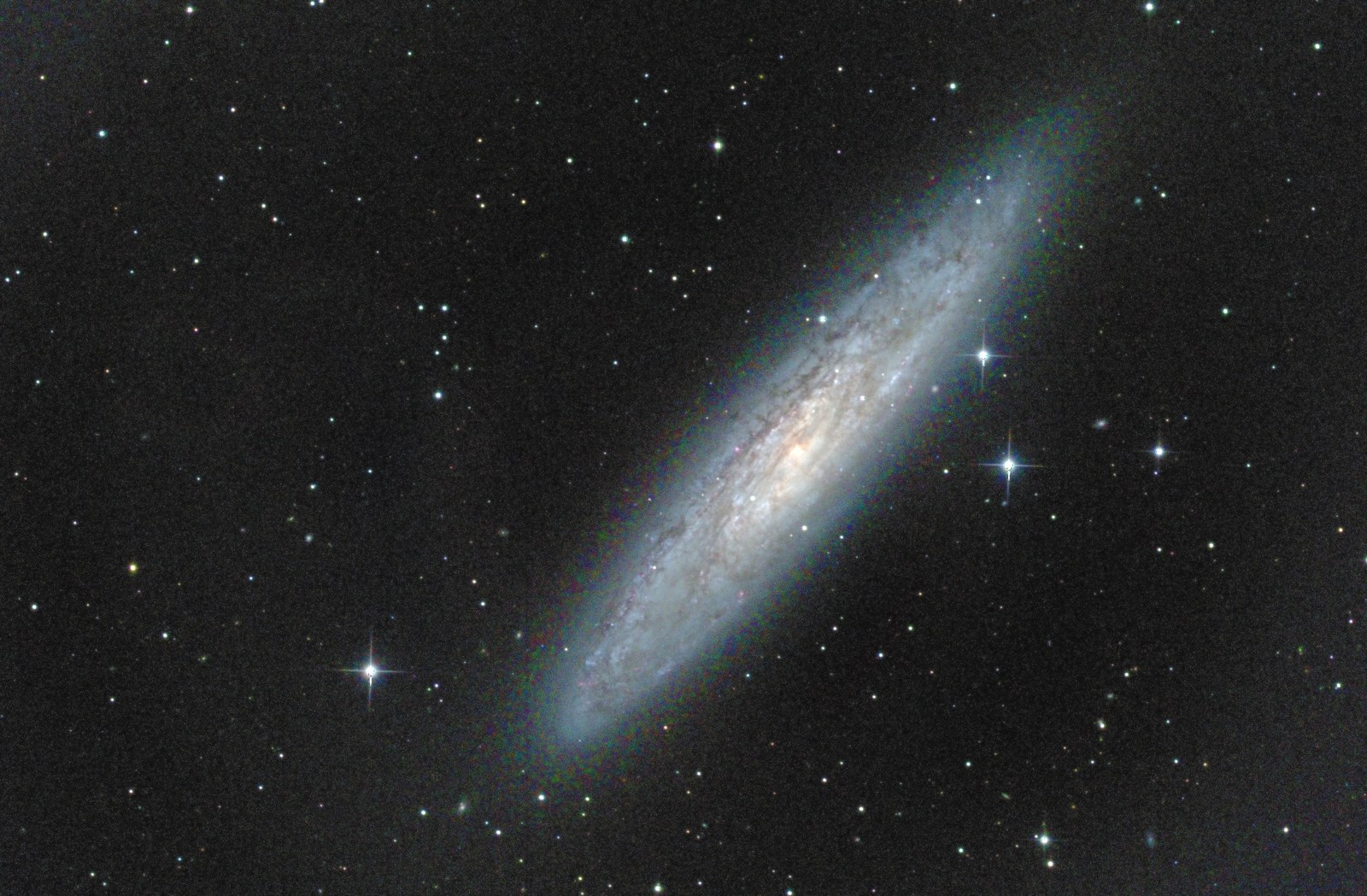
The target was NGC 253, the Sculptor Galaxy (shown above), and at midnight in Australia it was eighty-four degrees up, very nearly overhead. It's about eleven million light-years away, one of the nearest big spirals to the Milky Way, and it's tipped almost edge-on to Earth, which is why it looks like a tilted silver blade. Some people call it the Silver Coin.
It's a starburst galaxy, making new stars far faster than the Milky Way does. The dark streaks across the disk are dust lanes, the golden glow at the center is older stars, and the blue along the arms is young ones. If you look closely there are a few small pink knots, clouds of hydrogen lit up by stars that were born there.
Caroline Herschel found it in 1783, sweeping the sky from England, where it barely clears thirteen degrees above the horizon. From my backyard in Cloverdale it never gets higher than about twenty-six. From Siding Spring it goes straight overhead, and on Wednesday morning, my time, a twenty-inch telescope spent an hour pointed at it on my behalf for free.
The tab
Saturn, on Sunday, was thirty-seven points. The Dumbbell and the Sculptor came to zero. At the regular rate, the Sculptor's thirty-six minutes on T30 alone would have come to close to a hundred.
The Moon is waning now, and the banner will come down in a day or two. The next happy hour starts around October 21, and the Chile bookings for the eighth and ninth are still on the calendar if the power comes back. I'll be ready. This time I'll order everything at once.
Addendum: how the pictures were made
For anyone who wants the numbers. Python on a laptop, astropy, numpy, scipy and photutils, and two new short scripts written along the way.
M27. Telescope T24, Sierra Remote Observatory: a twenty-four-inch reflector at 3,962 mm focal length, 7.52 µm pixels after 2×2 binning, 0.39 arcseconds per pixel and a field of 31 by 21 arcminutes. Four 120-second frames through a hydrogen-alpha filter and four through oxygen-III, with a small random offset (a dither) between frames, from 00:51 to 01:13 PDT on September 30, the nebula sinking from 31° to 27° altitude, the Moon 98° away and 84 percent lit. The frames carry no plate solution, so they were aligned on stars. My usual method, phase correlation, reported shifts of under a fifth of a pixel between frames. Measuring a few bright stars by hand showed the real offsets were up to 22 pixels: the correlation had locked onto the camera's own fixed pattern, which doesn't move when the telescope does. So I wrote a star matcher. It finds about sixty stars in each frame, votes on the offset that lines up the most pairs, and takes the median of the matched pairs as the shift. Each filter was then averaged with median-centered sigma clipping. The finish is the bicolor palette usually written HOO: hydrogen into red, oxygen into blue, and green made from four parts oxygen and one part hydrogen, which warms the teal a little. Each channel got a gentle curved sky model, fitted to the dimmest fifth of each 200-pixel tile with the tiles on the nebula thrown out, then an inverse hyperbolic sine stretch. Stars come out tinted in a two-filter image, so small bright points were pulled most of the way back to white.
NGC 253. Telescope T30, Siding Spring: a twenty-inch at 2,262 mm with an FLI 6303 camera, 9 µm pixels, 0.82 arcseconds per pixel unbinned, a field of 42 by 28 arcminutes. Six 120-second luminance frames at full resolution, then four each of red, green and blue binned 2×2, all dithered, from 00:26 to 01:14 local time on October 1, the galaxy at 84° altitude. The Moon was 82 percent lit and 66° away, two degrees closer than the 68° iTelescope's software likes to see at that phase, and it lifted the sky to about 1,400 counts per frame. Each filter was star-matched and stacked on its own; the color stacks were then enlarged 2× onto the luminance grid and star-matched to it, about 240 stars each. The galaxy is some 2,000 pixels long in a 3,072-pixel frame, and my standard background model, which works in 256-pixel boxes, mistook the outer disk for sky and cut it off. The replacement is a smooth quadratic surface fitted to 128-pixel tiles, with a mask grown over everything a heavily blurred copy lifts above the sky. Luminance carries the detail and the color stacks carry the color. The color noise was blurred without touching the detail, and saturation was weighted by brightness so the galaxy gets color and the sky stays a quiet grey.
What it cost. Nothing. Both runs were logged as Full Moon Happy Hour sessions, not billed. Yay!
Sources: the T24 and T30 run logs for September 30 and October 1, 2026; the FITS headers of every frame; iTelescope's Full Moon Happy Hour notice. Distances: M27 about 1,300 light-years; NGC 253 about 11 million.
Related: The Rings Are Opening, Saturn for thirty-seven points.
Elsewhere: iTelescope, The network: Siding Spring, Chile, Spain, Utah.