KOBS · 20.22 · The Observatory · essay ·
The Rings Are Opening
I booked half an hour on a telescope in Chile and went to bed. By morning I had Saturn nearly edge-on, five of its moons, and the Elephant's Trunk.
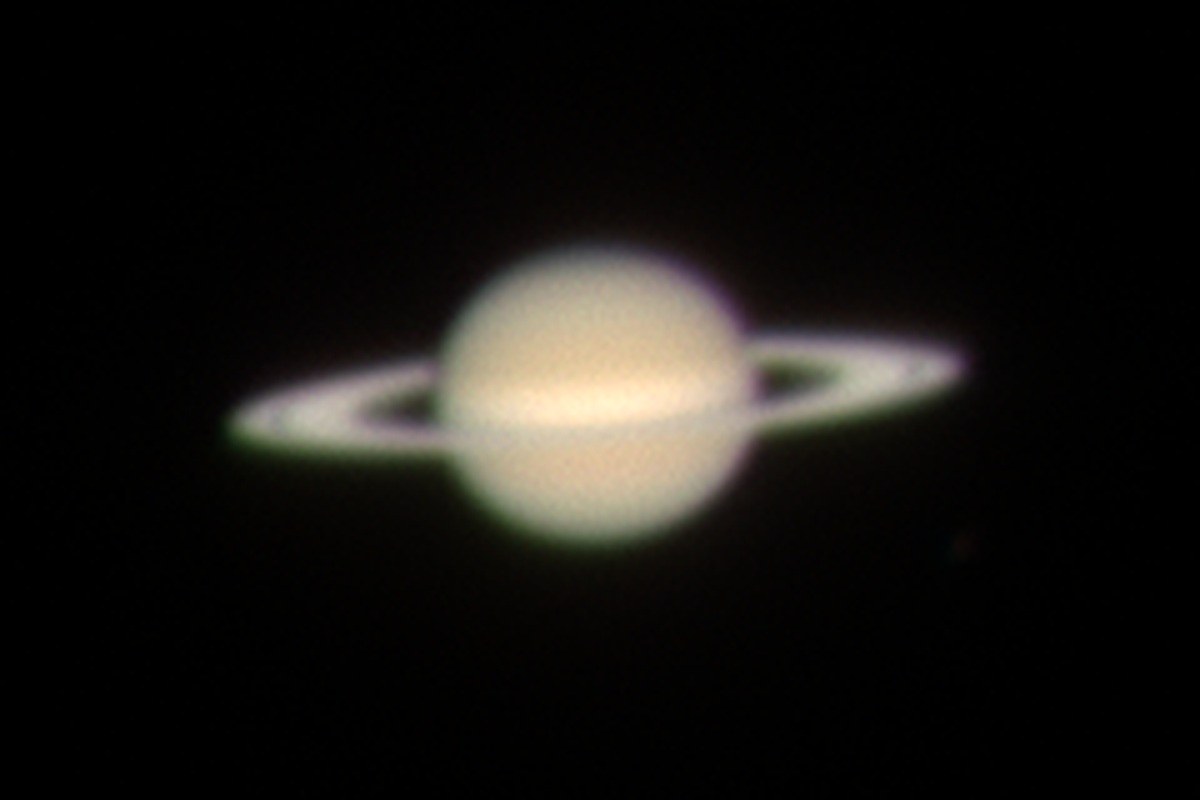
In the last post I said the next picture from Chile would be on this page within a week. It took one night. On Sunday I booked half an hour on a seventeen-inch telescope in the Río Hurtado Valley, pointed it at Saturn, and went to bed. When I woke up there were forty-three frames waiting on the server, and by lunch Saturn was on my screen with its rings nearly edge-on and five of its moons lined up beside it.
The free hour that got away
The plan was to shoot Saturn live, for free. Around every full moon iTelescope opens its telescopes to members at no cost for an hour of live imaging, because the bright sky scares off the people chasing faint galaxies, and planets don't mind the moonlight. I sat down at nine o'clock on Sunday night ready to go. The Chilean telescope was taken, another member already on it, and a paying reservation right behind them. I tried Utah. Every roof was shut. I tried the observatory in the Sierra Nevada in California and someone got there two minutes before I did.
So I did what the reservation system is for. I booked the first slot the calendar would give me, half past midnight my time, and let it run while I slept. It cost thirty-seven points, about the price of a nice lunch. The log says the telescope opened on schedule, focused itself, found Saturn, and took every frame I'd asked for. It also complained, over and over, that the Moon was too close to the target. At full moon the Moon and Saturn sit near each other in the sky, and the telescope noticed.
Saturn
Saturn's rings are enormous and almost impossibly thin, and every fifteen years or so they turn edge-on to Earth and nearly vanish. That happened in March 2025. Since then they've been tilting slowly back open, and in this picture they're a bright blade cutting across the planet, with the thin dark gap between ring and globe showing on both sides and the ring's shadow lying across the planet's face. Saturn reaches opposition on October 4, closest and brightest for the year, and the rings will keep opening for the next seven years.
The picture is soft, and I want to say plainly why. Saturn was only thirty-eight to forty-nine degrees above the horizon while it was being shot, which means its light crossed a lot of air, and the Moon was lighting up the sky right beside it. Planetary imagers get their sharpest pictures by shooting thousands of video frames and keeping the steady instants. I had forty. It's still Saturn, from a telescope in Chile, taken while I slept, and I'm keeping it.
Five of 274
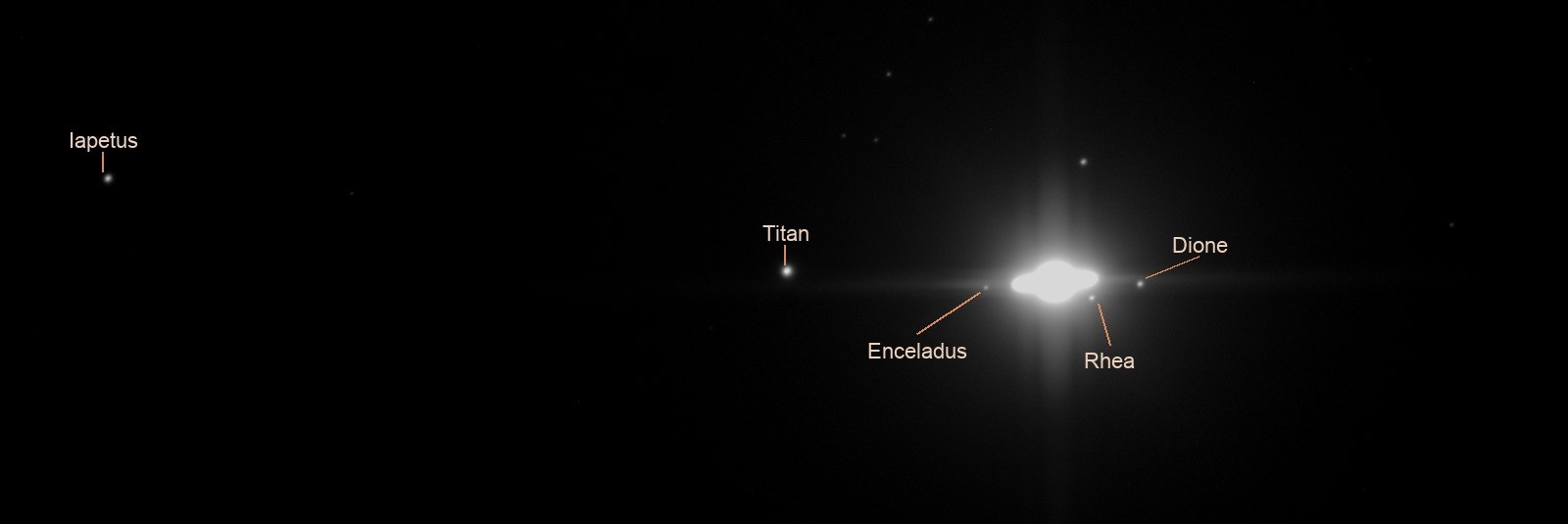
Saturn has 274 known moons, the most of any planet, and the count keeps rising as surveys find more. Almost all of them are tiny, a few miles across. A handful are big enough to catch, and for that I asked the telescope for three longer exposures that burn Saturn out on purpose so the faint points around it can show.
I didn't want to guess which point was which, so I checked every one against NASA's ephemeris for the minute the frames were taken. Five line up. Titan, the big one, larger than the planet Mercury and wrapped in an orange haze thick enough to hide its lakes of liquid methane. Iapetus, far out on the left, a moon with one hemisphere as dark as coal and the other bright as snow. Rhea, the second largest, and Dione, and Enceladus, small and close to the rings, which sprays water ice into space from an ocean under its crust. Tethys was hiding in the glare.
The Elephant's Trunk
The other new picture is the August gift from iTelescope, unprocessed frames from one of their observers, shot in July 2025 on a twenty-inch telescope in Utah. It's a region called the Elephant's Trunk, about 2,400 light-years away in Cepheus.
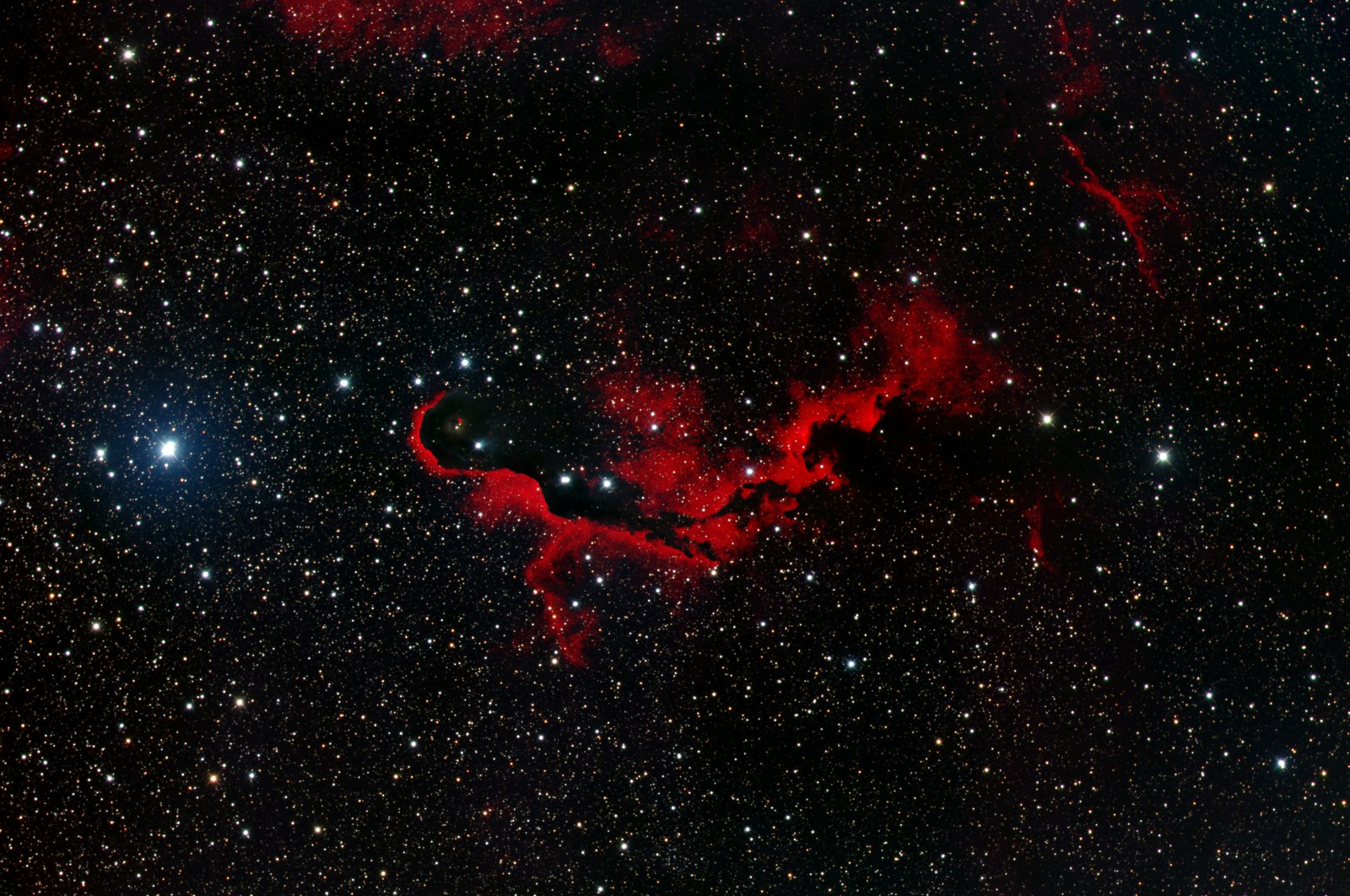
The trunk is a column of gas and dust more than twenty light-years long, sitting at the edge of a much bigger glowing cloud. At the heart of that cloud is a group of massive young stars, and their ultraviolet light does two things to the trunk. It makes the surface glow, which is the bright rim, and it slowly boils the column away, which is why the trunk has the sculpted shape of something being eroded. Inside, where the gas is squeezed, new stars are forming. The round hole in the elephant's head was blown out by one of them.
It came as six sets of frames, red, green and blue plus three filters that each pass the light of a single gas, so I made it twice. The first version is close to what your eye would see through a big enough telescope: the hydrogen glow red, the dust dark, the stars their own colors.
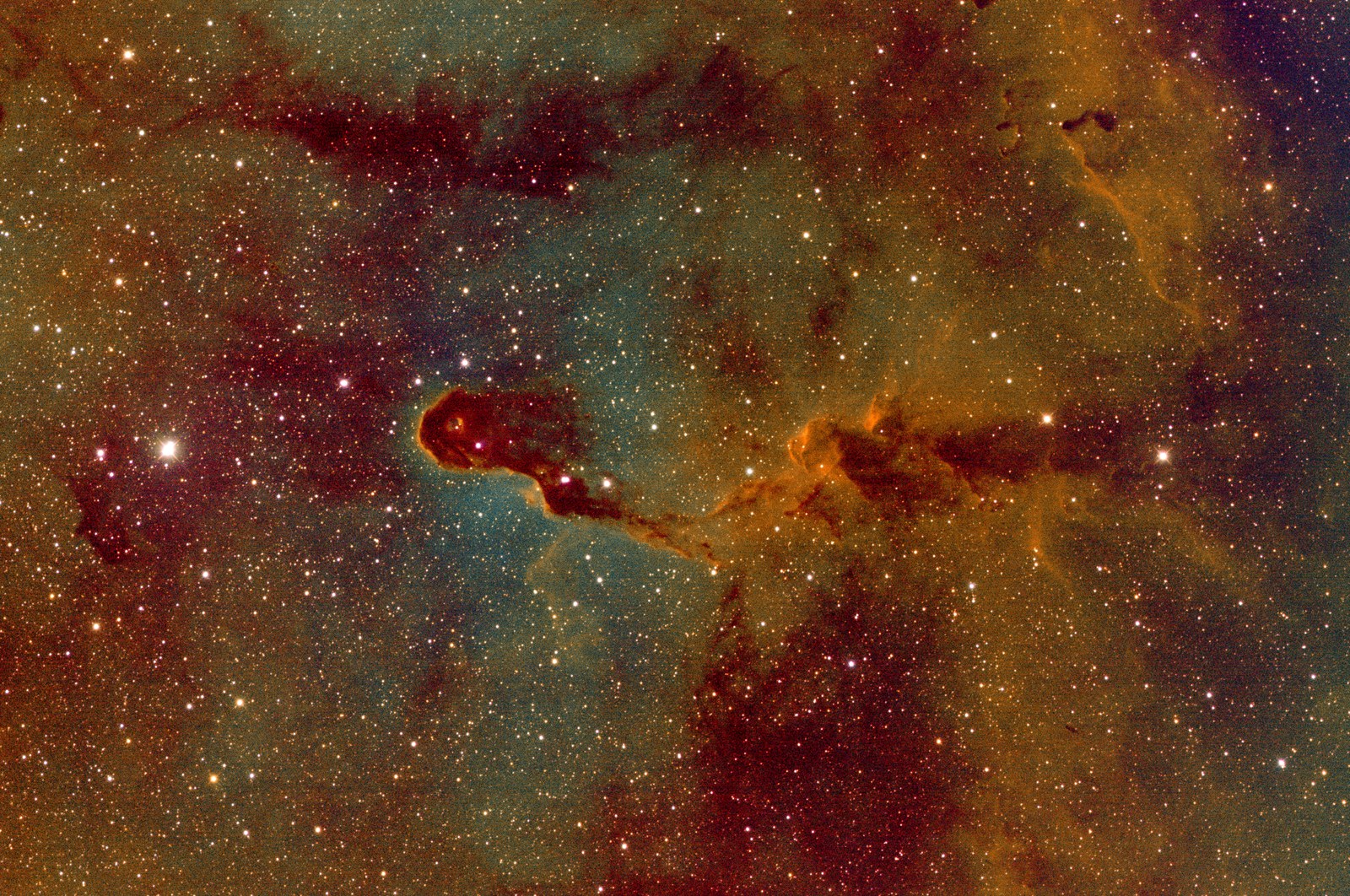
The second is the Hubble palette, the false-color scheme NASA made famous with the Pillars of Creation. Sulfur goes to red, hydrogen to green, oxygen to blue, and each is stretched on its own so the faint gases show as clearly as the bright one. The colors are a map of chemistry, gold where hydrogen and sulfur dominate and teal where oxygen glows. The whole cloud the trunk lives in comes out of the dark.
October
The rest of the month is booked. On the night of October 8 the same Chilean telescope goes back to NGC 1365, the Great Barred Spiral, to add to the frames I took in 2024. The night after, it turns to the Tarantula Nebula, a star-forming region in the Large Magellanic Cloud, a small galaxy next door to the Milky Way. Both nights are moonless. I'll be asleep for both, and that seems to be how this works now.
Addendum: how the pictures were made
For anyone who wants the numbers. Python on a laptop, astropy, numpy, scipy, and three new short scripts, written as I went.
Saturn. Telescope T73, Deep Sky Chile, latitude 30.5° south: a Planewave CDK17 at 2563 mm with a ZWO ASI2600MM, 3.76 µm pixels, 0.30 arcseconds per pixel, unbinned. The plan was ten frames each of luminance at 0.05 s, red and green at 0.15 s, blue at 0.2 s, and three luminance frames of 5 s for the moons, 43 in all, run by reservation from 07:30 to 07:50 UTC on September 28. Peaks landed between 31,000 and 38,000 counts, about half of full scale, so nothing clipped. For each frame I found the planet, cut a 420-pixel square around it, and scored sharpness as the variance of the Laplacian over the disk. The best seven of ten in each filter were aligned by FFT phase correlation with a parabolic fit to the correlation peak, which gives sub-pixel shifts, and averaged. The colour stacks were registered onto luminance (shifts of about half a pixel, and 1.5 px for blue), balanced on the disk with a slight warm cast, and luminance applied as the detail layer. A two-scale unsharp mask did the sharpening. The green and violet fringes at the ring tips are atmospheric dispersion: at 40° altitude the air acts as a weak prism and the colours land a fraction of an arcsecond apart. An atmospheric dispersion corrector fixes that at the telescope; stacking can only partly undo it.
The moons. I averaged the three 5 s frames, found Saturn's centre from the saturated blob, removed the glare with a 25-pixel median filter, and looked for point sources. Then I pulled geocentric positions for Mimas through Iapetus from JPL Horizons for 07:50 UTC and converted the offsets from Saturn to pixels at 0.303 arcseconds per pixel. Allowing a field rotation of 1.3°, measured from Titan, Titan lands within 2 px of its prediction 497 px out, Iapetus within 8 px at 1,760 px (half a percent), and Rhea, Dione and Enceladus within a pixel each, at 290 to 1,550 times the local noise. Tethys was inside the saturated disk. Mimas's predicted spot is at the ring tip, where the glare leaves a peak I can't separate from the ring, so it isn't labeled.
The Elephant's Trunk. The August 2026 Premium Image Set, Plan-40 tier: T26, a Planewave Delta Rho 500 at 1537 mm with a ZWO ASI6200MM, binned 2×2 for 1.0 arcsecond per pixel and a field of 1.34 by 0.90 degrees. Four calibrated 300 s frames in each of red, green, blue, hydrogen-alpha, oxygen-III and sulfur-II, the narrowband on July 19, 2025 and the colour on July 26. My first attempt aligned everything to one red frame and rejected half the narrowband frames, because a narrowband frame shows far fewer stars and a different nebula than a red one. So each filter was aligned to its own first frame and stacked, and only the six clean stacks were matched to each other. That exposed a rotation of 0.30° to 0.35° between the two nights, which I found by searching angles for the best star-only correlation. Averaging used median-centred clipping with a robust spread estimate, which removed a satellite trail that four-frame standard-deviation clipping had let through. The field is nebula to the corners, so the background model is a gentle quadratic surface fitted to the darkest tenth of each 256-pixel tile. The natural version adds hydrogen-alpha's excess over red back into red. The Hubble version maps sulfur, hydrogen and oxygen to red, green and blue, stretches each on its own, pulls green down toward the average of red and blue (the step known as SCNR), lifts red where it beats blue for the gold, and desaturates the stars, which otherwise come out pink.
What it cost. Saturn took 37 points: twenty minutes of session time, which the planet's sub-second exposures force, at a 25 percent full-moon discount. The two premium sets came with the membership.
Sources: the T73 run log and my iTelescope account history for September 28, 2026; the FITS headers of every frame; JPL Horizons ephemerides for Saturn's moons at 07:50 UTC that morning; iTelescope's release notes for the August 2026 Premium Image Set. The Elephant's Trunk frames were taken by an iTelescope observer and remain their copyright; the developed images are published with their standing permission to members.
Related: Couldn't Wait, the night before this one.
Elsewhere: iTelescope, The network: Siding Spring, Chile, Spain, Utah.