KOBS · 20.22 · The Observatory · essay ·
Every Continent
I asked for a telescope for Christmas. Aldo went big. Ten minutes to Andromeda, and a balance waiting for October.
For Christmas in 2023 I asked for a telescope. What I meant was a tube on a tripod in the back yard, the kind you point at Saturn and squint through. Aldo knew a telescope would ultimately sit in a closet gathering dust. I had owned them before, and he had watched what happened. So he found a better solution, a techier one, and he went big. He gave me telescopes on every continent. This is the story of that gift: the ten minutes it took to reach another galaxy, and a month of sky still waiting to be spent.
That is nearly the truth. iTelescope is a network of remote observatories, a couple of dozen instruments in four of the darkest places anybody has bothered to put a dome: Siding Spring in New South Wales, the Atacama in Chile, a mountain in Spain, and the high desert of southern Utah. You join, you book time, you point a telescope from a browser, and the photons come to you. When it is daylight in Cloverdale it is night in Australia. When it is cloudy in Utah it is clear in Chile. The southern sky, which I would otherwise have to fly to, is one tab over. It is a wonderful idea, and it is the kind of thing he finds.
Ten minutes
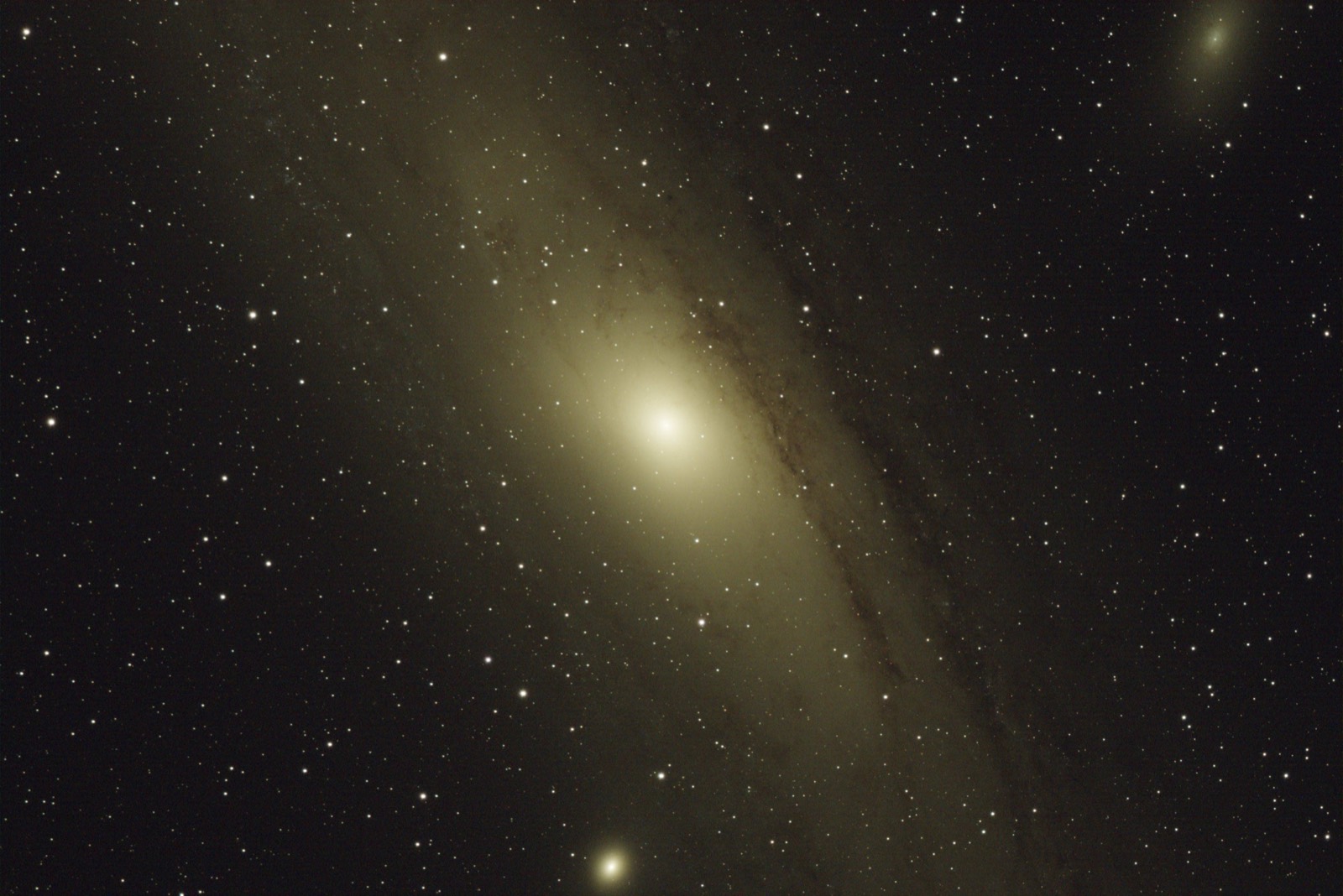
The membership went through at four minutes past eight on the evening of January 2, 2024. At fourteen minutes past eight a six-inch refractor in the Utah desert opened its shutter on the Andromeda galaxy and held it open for two minutes, and then the picture was on my laptop. Ten minutes from the receipt to another galaxy. It is one raw frame, exactly as the camera handed it over, and it is the picture at the top of this page.
The galaxy fills the frame corner to corner, tilted, with a core that burns out to white and dust lanes curving through the far arm like something combed. Below it is the small bright smudge of M32, one of its satellites, and up in the corner the fainter oval of M110, the other. Every star in the field is in our own galaxy, in the foreground. Everything soft is two and a half million light-years away, and the light in that frame is two and a half million years old.
Five nights later I had one point left. The account had come with sixty and I spent fifty-nine of them on the first week of January, which is what happens when you give someone telescopes on every continent. I bought more. The plan renewed monthly through the spring. Then other things took the evenings: a website, a rover, a book written a chapter at a time, a deck of cards, three films, a desk companion that sweeps and speaks, and the balance sat where I left it. The points are still there. The plan follows.
October
The plan for spending it was written in July. One month of membership, activated at the start of October, so that the twenty-eight days cover the new moon on the tenth for the faint things and the full moon on the twenty-sixth, when the rates drop, for the bright ones. Saturn is at opposition on October 4, closest and brightest of the year, and the rings, which turned edge-on to us in 2025 and vanished, are tilting back open. We photograph them returning.
The rest of the list: a supernova, whichever one is going off in a photogenic galaxy that month, shot three or four times across the weeks so that a dying star visibly fades from frame to frame. An asteroid photographed on consecutive nights and blinked, the way Tombaugh found Pluto. The Crab Nebula on a big scope from Utah or Spain, deep enough to show the pulsar at its heart, a city-sized star spinning thirty times a second. The Tarantula Nebula from Siding Spring, a nebula in another galaxy. Orion late at night from Utah. And a set of gift photographs for the neighbors at Lake Sonoma, each one chosen by a rule they do not know about: an object whose light left it the year they were born, or an asteroid that carries their name, or whatever is hidden inside their constellation.
None of it has been shot. The points are waiting. Time permitting, October is the month, and if time does not permit, the plan keeps. It is a month set aside for exceptions, some of which cannot be scheduled, with observatories in both hemispheres standing by. The sky is patient, and so, it turns out, is a prepaid balance.
The exception
This station inherits a rule from The Darkroom: the pictures are photographs, and I took them. The sky bends the rule, and the bend is the reason the station exists. I cannot stand in the Utah desert and on a mountain in New South Wales in the same night, but I can open a shutter in both, and the photons that arrive are as much mine as any I have caught with a camera in my hand. That is the exception, and it is why the October run is called Interstellar Exceptions.
There's a second bend: I have an assistant at the keyboard with me. Claude, Anthropic's AI, is providing invaluable assistance. I choose what to shoot and what to publish, and the photons are mine. The hours and the code are shared.
The receipt says four minutes past eight. The frame says fourteen past. I have kept both, because the gap between them is the gift. He did not give me a telescope. He gave me ten minutes to Andromeda, and every continent, and a balance I have not finished spending.
Sources: the iTelescope receipts of January 2, 2024 and after; the frame's own header (telescope T02, Utah, 150 mm aperture, 120 seconds, January 3, 2024, 04:14 UTC); and the October plan written July 27, 2026. iTelescope's sites are at Siding Spring Observatory in Australia, near Nerpio in Spain, in Chile, and in the Utah desert. Andromeda's distance is about 2.5 million light-years.
Related: Yay, It Moves, another thing we drive from a browser.
Elsewhere: iTelescope, The network: Siding Spring, Chile, Spain, Utah.