KMAK · 20.18 · The Work Bench · essay ·
This One Works
Four speakers that were too big for a rover, the three sculptures they are going to become, and the printer we are still waiting for.
In May I ordered two small speakers for Scotty, so that a rover could say "She cannae go that way, Captain" when he met a wall. Tang Band W1-1070SI, one-inch full-range drivers in sealed modules, a closeout at Parts Express for $14.98 each. I bought them for the sound. Four arrived instead of two, and each one, with its module, is about two inches square. Set one next to the rover and it is way too big. Scotty has three quarters of an inch of free metal above his nameplate and nothing may hang below the chassis. This is what happened to the four that did not fit: three sculptures, a series with a name, and a printer we are still waiting for.
So on the evening of Sunday, June 1, I opened a new session and typed that this was more Scotty adjacent than Scotty. The four drivers were on the desk, and the question was what I could design and print to put them in. The answer got a name before midnight and has three members now, and none of them exists yet. This is the story of a project at the stage where the drawings are done and the machine to make them is not in the house. I think that stage is worth a transmission of its own, because it is where many projects on this bench spend their lives.
Dreaming first
I said let's start with the dreaming. I wanted an ambient sound object with USB charging and six hours of battery, and I had two things in my head. One was Stereolab's Music for the Amorphous Body Study Center, which they recorded for a show of Charles Long's sculptures. I saw it with friends at the Walker Art Center in Minneapolis, in 1998 I think, and it was the most fun I have ever had at a museum. The other was Brancusi's Bird in Space. I am not, generally, super amorphous. I wanted the bird.
The third thing came out a few minutes later, when we got to finishes. Bang & Olufsen are my North Star. I can't afford their big speakers, but I have two of their little ones, the Beosound Explore, ribbed aluminum cans that live on a shelf when they're not on assignment, and I sent a photo of them. They may be a bit brutal, but I do love the horizontal lines. So the brief assembled itself in about twenty minutes: Brancusi's silhouette, B&O's ribs, the driver hidden inside, sound leaking out through the gaps between the ribs so that the sculpture itself seems to be the thing playing. Battery in the base for ballast, and clever baffles above it doing the acoustic work.
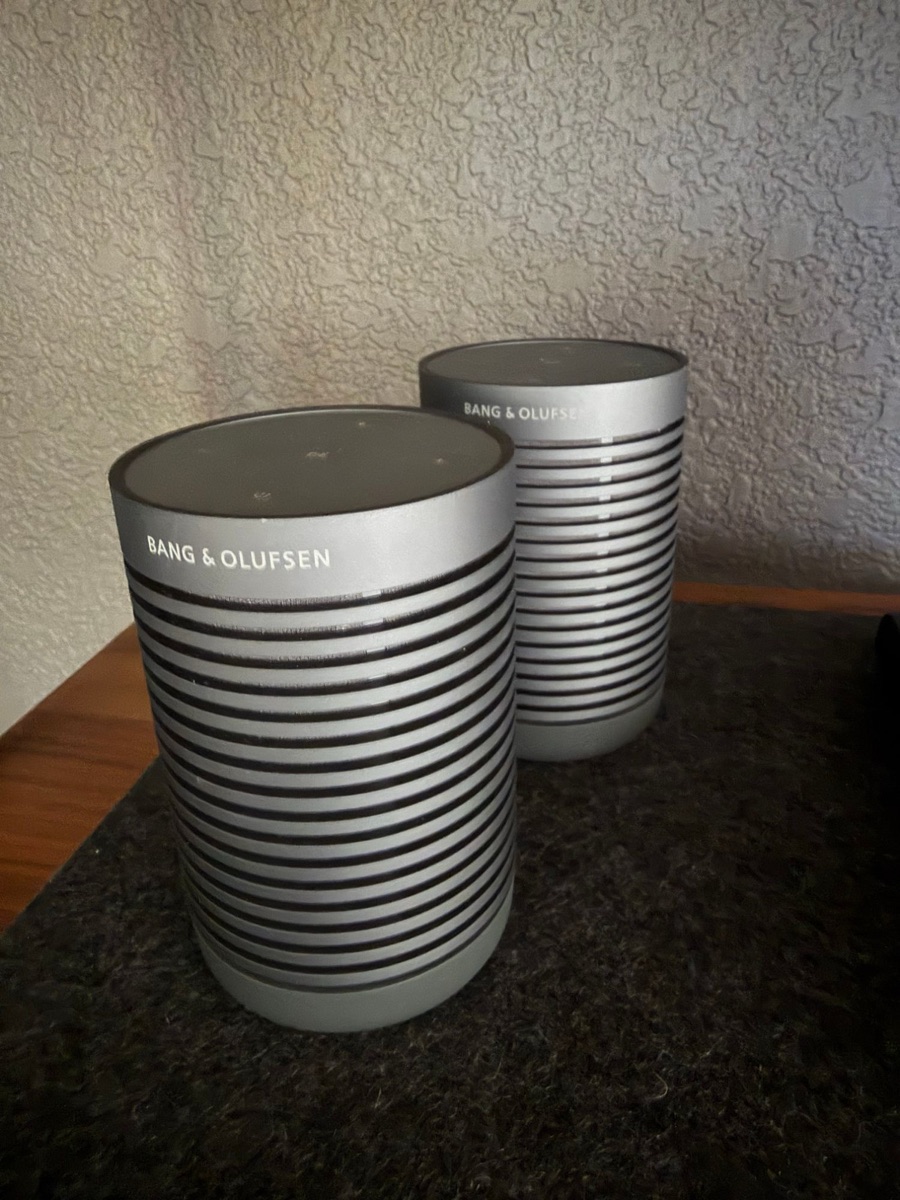
Some decisions came easily because I know what I do not want. Bluetooth first, with the hardware to add AirPlay later, since the WiFi is already on the chip. Mono, like a HomePod mini. My B&Os do the stereo pairing thing and it can be trying to set up. Keep it simple. An ESP32-S3 for a brain, a small I2S amplifier, one 18650 cell, a USB-C charger board, a touch pad instead of a button, an amber LED for a heartbeat. We priced the electronics at twenty-five to thirty-five dollars a unit and I wrote, at nine that night, that if it was as cool as it sounded I knew what friends were getting for Christmas.
Then I asked about the tool. The Sonoma County Library has a Prusa MK4 you can book, with a bed about ten inches by eight and a four-hour limit per job, which means anything tall gets printed in sections. Fusion 360 has a free personal license. PrusaSlicer is free. I have never modeled anything in three dimensions in my life. We're starting from zero, and I can't wait.
Seal or penguin
Just before eleven I asked for a description of the outside of the sculpture detailed enough to hand to an image generator, polished silver, and took it to ChatGPT. The first picture came back three minutes later.
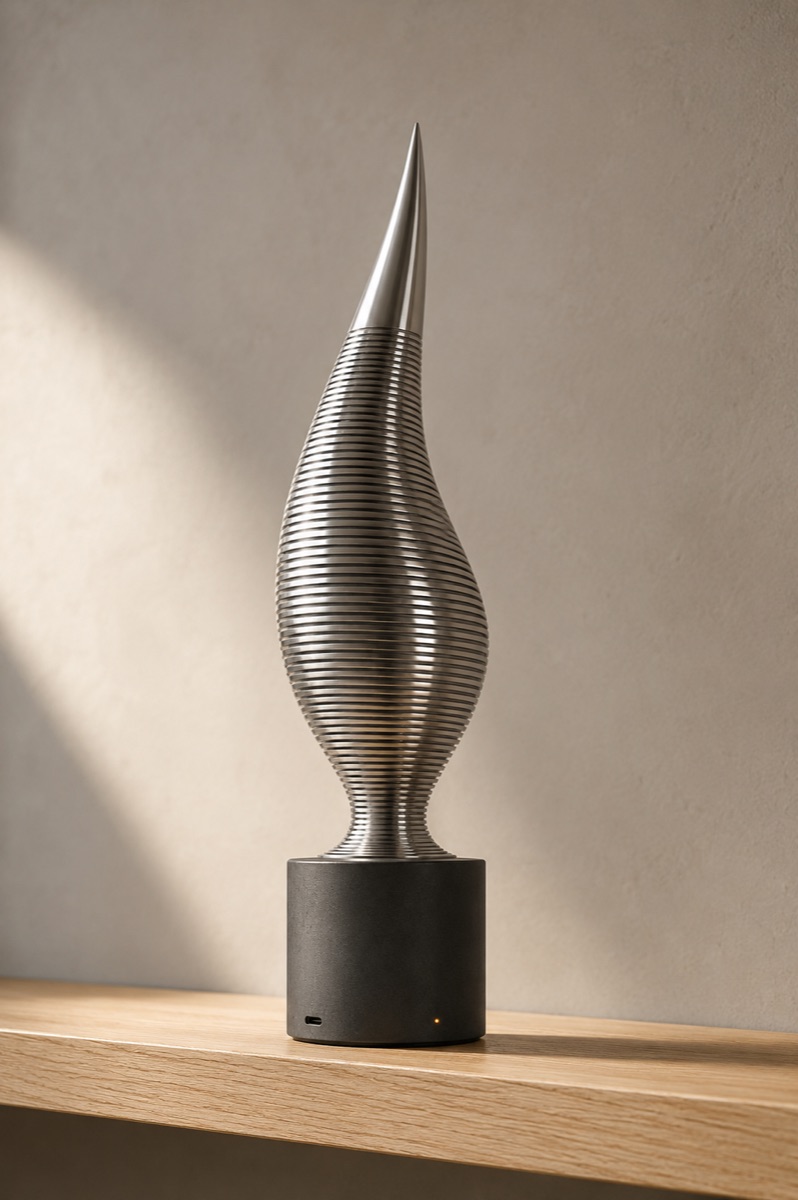
Not bad at all. But it read more as seal or penguin than as a sleek bird. The belly was too low and too round, and the whole thing sat on its base like something waiting to be fed. I asked to tighten it up and still leave room for the electronics, and the answer was to move the driver down into the base and let the body be a pure shape. That gave the base its job, a charcoal cylinder two and a half inches across holding everything that hums, and let the bird be a bird.
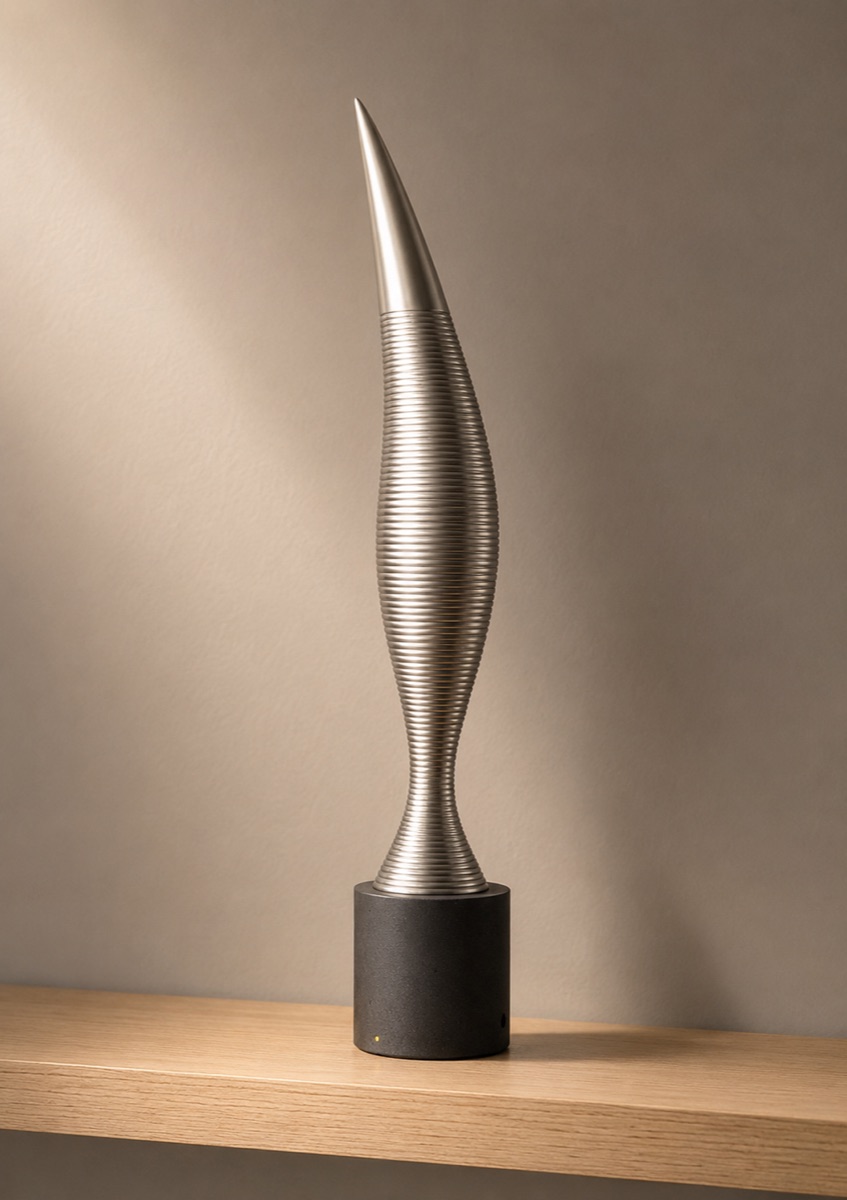
Getting the bird right took four more tries and was entirely a problem of language. The shape I wanted starts wide where it meets the base, narrows to a waist three quarters of an inch across, swells to two inches about a third of the way up, and then tapers in one long unbroken curve to a point, with the ribs stopping an inch and a half below the tip so the crown is smooth. The prompts kept losing the bottom of that. One version dropped the foot entirely. One described a slender neck connector as the narrowest point of the whole sculpture, which makes it sound like it starts off skinny and doesn't change. Still wrong, I wrote at 11:13. It should start out wider, then narrow, then swell. Somewhere in the middle of this I asked, as an aside, whether we should call the series Sound in Space, or SIS for short.
At 11:18 the picture came back and I typed the three words this piece is named for. This one works. The foot flares, the waist pinches, the belly swells and the whole thing leans a little, like it is about to leave. It is nine inches tall on paper. It is about six and a quarter inches of ribbed silver on a base two and three quarters high, with a six-millimeter brass rod running up through the neck so the narrow part does not snap when someone dusts it.
Why make them all the same
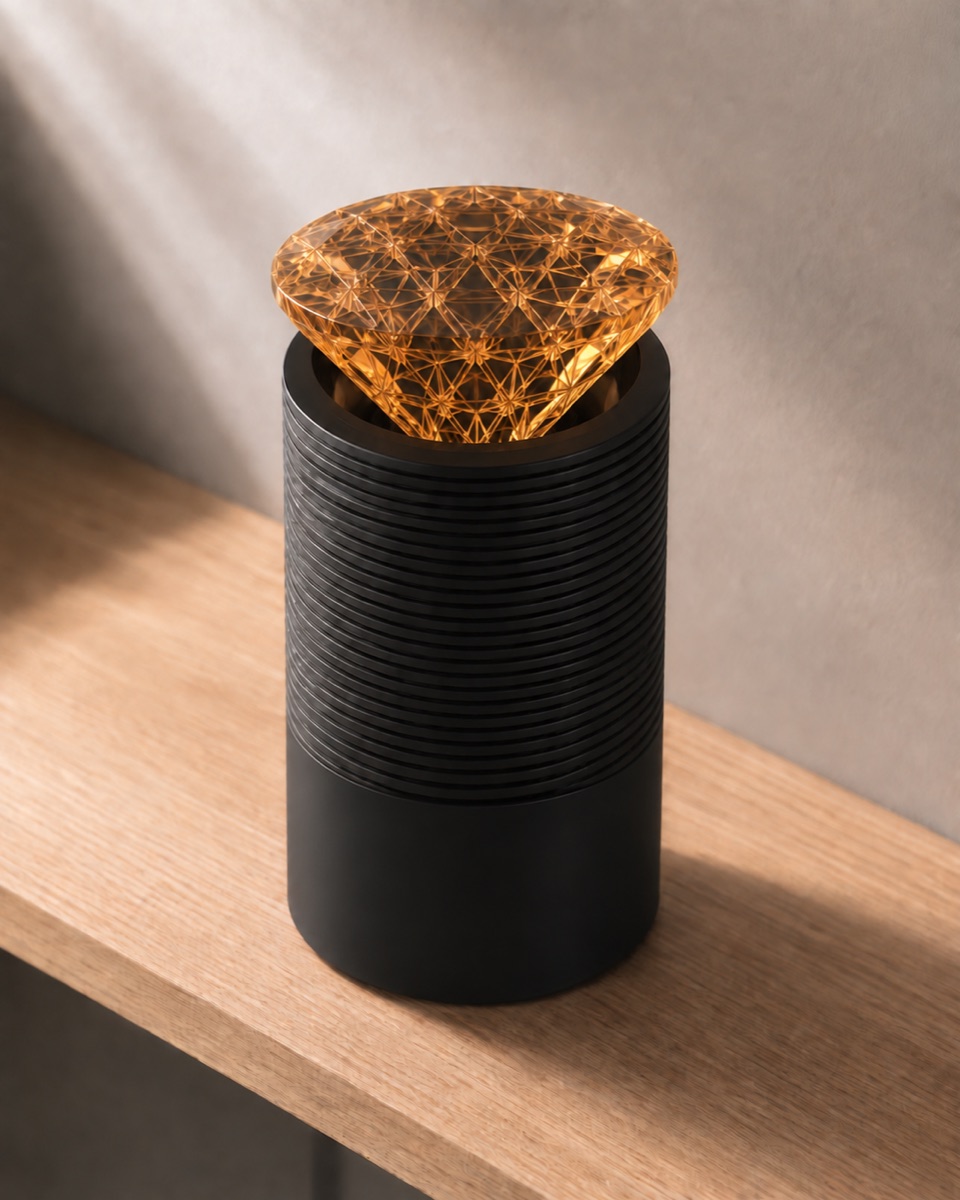
I woke up on Monday with a fun thought, which was that I had four drivers and no rule that said the four sculptures had to match. By 10:41 I was describing a second one: a plain column like the B&Os, the speaker firing straight up inside it, and a raised cap floating above the walls with a cone underneath pointing down into the driver to throw the sound out sideways through the gap. The question was whether the cap should be sealed or open so you could see the cone. Open. If it is sealed I think it will feel cheap, because it will be so light for the space it takes up. Open, it is clear that it should be light.
The column was harder to name because its distinguishing feature is the cone, and the cone made me think of black holes and event horizons. Horizon was fine. Corona was good, except for too many beer references in my head. Crown was out. And then I remembered Orchestra Hall in Minneapolis, an absolutely awesome place to hear music, where the whole ceiling is covered in big faceted cubes that scatter the sound. I heard Rachmaninoff's Second Piano Concerto there, my favorite night in that space, and Holst's The Planets, which I have always loved, and George Winston, who was awesome too. I asked whether our cone could be printed as a crystal lattice, so it reflects more and also looks like jewels. Tiara. ChatGPT got it on the first try, at 11:44, an amber geodesic cone sitting in a brushed steel ring on top of a black ribbed can, and I said so with the OMG that it deserved.
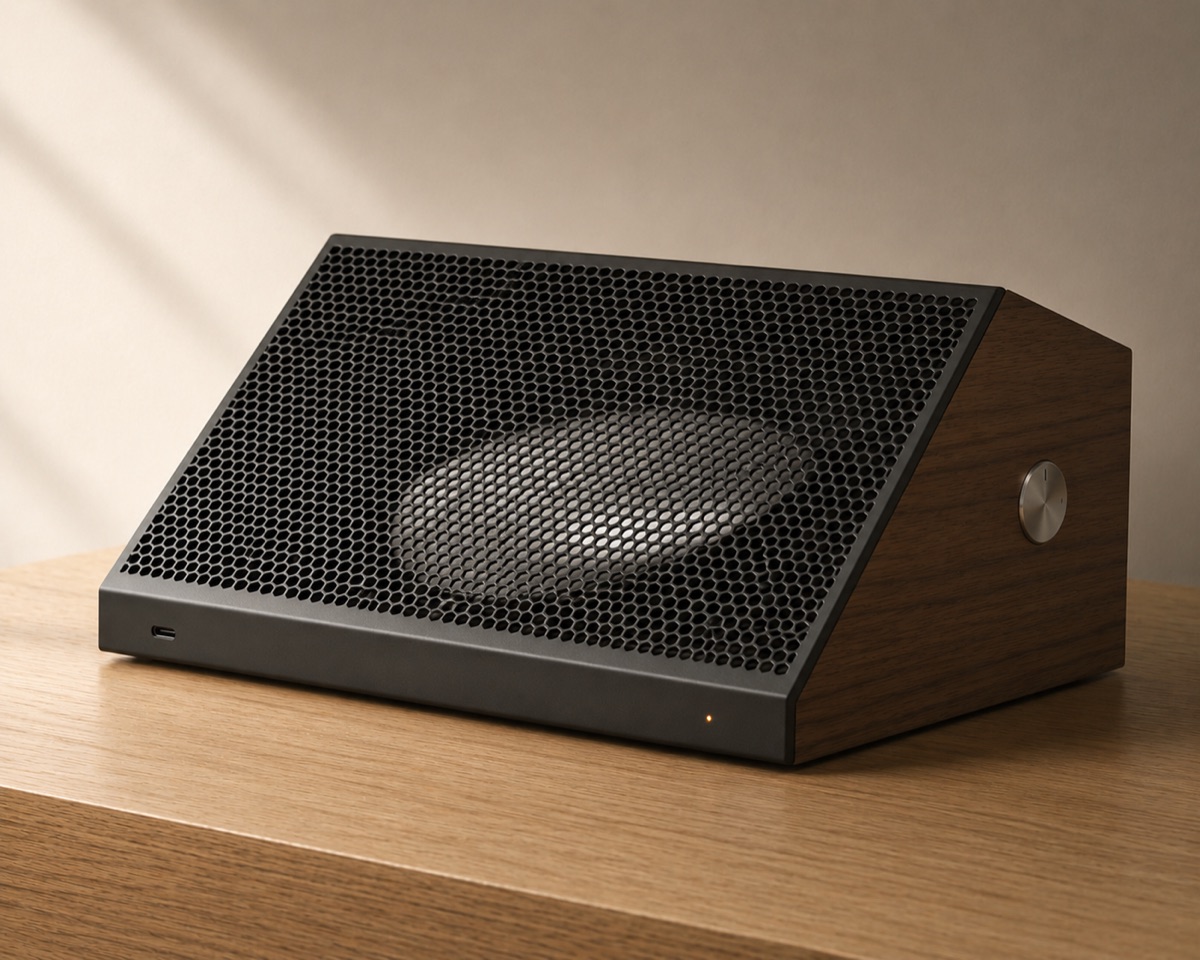
The open top had also reminded me, while the column was still nameless, of my sister Val's Bose 301s from the seventies, the ones with the angled tweeter on top and a little flap you could adjust to aim the reflection, all of it hidden behind foam. They mostly played disco, at high volume. Donna Summer's I Feel Love comes to mind. I loved those speakers. So there would have to be a third one, an homage to Bose, and by 11:22, before Tiara had its name, it had a shape: a low wedge, the driver firing upward at thirty degrees, since forty-five felt like too much, sides printed in a wood-fill plastic, and a wide open mesh across the top so you can see the reflector inside, with some stylish, B&O-worthy mechanism on the outside to tilt it. The name took three minutes. Reflect. It does both.
Flight and Tiara got one driver each, and by noon I had decided the two left over should both go in Reflect, wired for stereo, with two of those knobs, and something clever inside to widen the image from a single box. Great, we're set on that, I wrote at 12:14. I've got many weekends worth of projects, yay. The renders of Reflect were locked before that decision, so the picture below shows one knob. The plan has two.
On paper
On Tuesday I asked for the full technical requirements for Flight, and got thirteen sections: the waypoints, the two-piece body around the brass spine, a sealed chamber of about 120 milliliters above a forty-five degree reflector, the amplifier's pin assignments, an equalizer curve to give a one-inch driver some bass, four print jobs per unit adding up to about ten hours, an order of operations in Fusion 360 for someone who has never opened Fusion 360, and a bill of materials that came to fifty-five to sixty dollars once you counted the battery and the paint. I read all of it and asked one question, which was what the boost converter does. It holds the five-volt rail steady while the cell sags. Include it.
The printer
A week later, on the Sunday night of June 8, we decided to buy a printer instead of booking the library's. Partly so we could print whenever we wanted, and partly because there are other things in this house waiting to be made, handheld devices about the size of a phone, which is close enough to a nine-inch bird that one machine covers all of it. I did not know anything about 3D printers, so we started with an overview, and I asked how many inches 230 millimeters is, and whether we could not just build in sections and screw them together. We can. Flight standing whole is taller than the library's bed, so it was always going to be printed in pieces.
We landed on Bambu Lab, worked through their lineup, and I leaned toward the X2D over the cheaper P2S for one reason: two nozzles, so the supports inside a sealed speaker chamber can be printed in a material that dissolves and rinses out. That is the kind of feature you only care about once you have drawn the inside of a bird. Bambu had an anniversary sale coming later in the month, so we set up a search and waited.
It is late September and we are still waiting. There is no printer in the house, nothing has been printed, and the four Tang Bands turned up this week in a storage box, where they had been since June. Reading the record also turned up a mistake in Flight's spec, a chip that does not speak the kind of Bluetooth the spec assumes, which is cheaper to find on paper than on the bench. So the state of Sound in Space is three names, a folder of renders, one document, four drivers, and a decision about a sale. When the printer arrives, the first thing off it will be a base two and a half inches across, charcoal, with a hole for a touch pad and a hole for an amber light, and I will find out what I got wrong in the drawings. I've got many weekends worth of projects, and I still can't wait.
Addendum: the bird
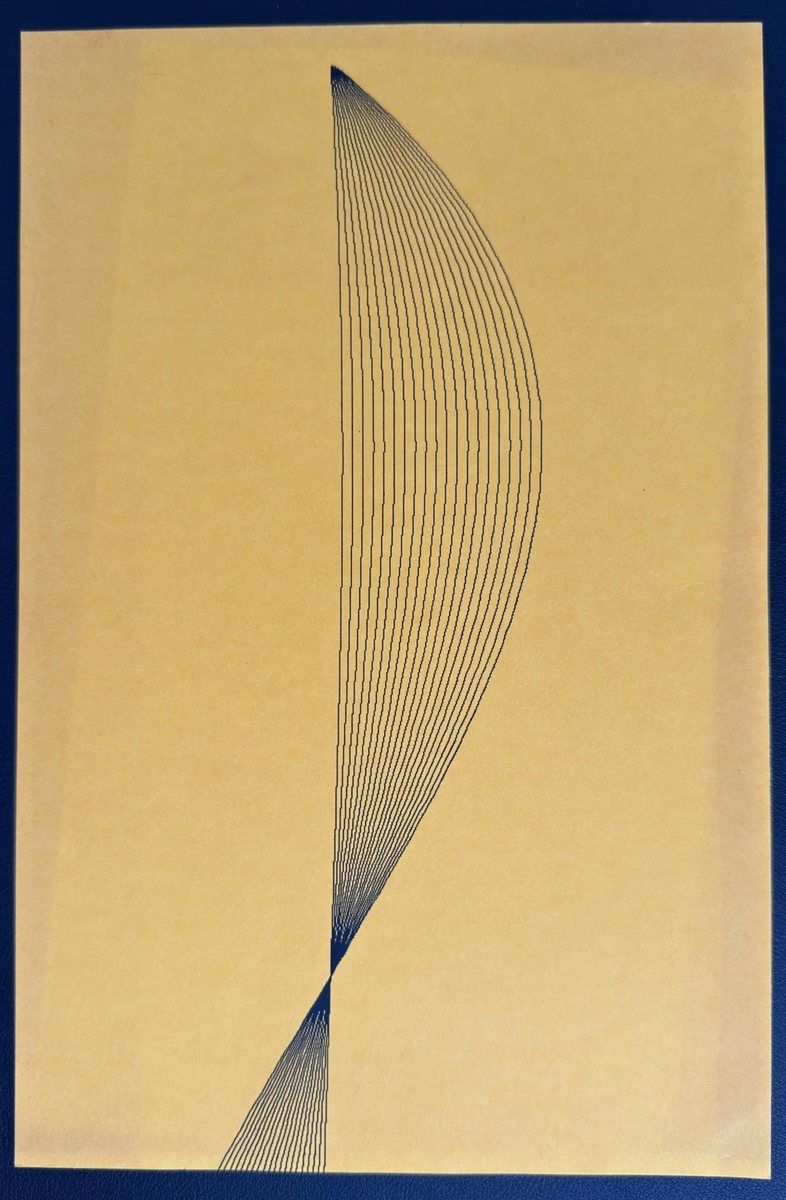
The bird has a longer history with me than one June evening shows. I first saw Bird in Space in art history, and I loved it immediately. My minimalist yearnings, which I had at twenty without a name for them, were fully realized in that one polished shape. Then, not long after, a class assigned us to make some computer art. This was the early eighties. Computers were not making art at that time. I was using punch cards to register for classes with them.
I did not remember which class, so I looked. The University of Minnesota's program report, the same sheet whose file number named another transmission here, has both. Introduction to the Visual Arts, spring quarter 1983, the quarter my major changed from electrical engineering to computer science. And the next winter, 1984, a four-credit computer science course the report abbreviates as Computers, Arts, Lit, sitting between financial accounting and my first algorithms class. So the bird came in the spring and the assignment came the following winter.
The submission survived, in the same box the program report came out of, misfiled for a few weeks as a blank page because the scanner could read no words on it. It is Bird in Space made of nothing but lines, about twenty of them, rising from a point at the foot, bowing out and bending back to a point at the crown, printed on gold cardstock. Tucked in with it were a proof on plain paper and the note that came back, two words in red ink: "100" and "beautiful!" I got an A. It took another forty-two years, and four speakers that did not fit a rover, for the shape and the code to meet again.
Sources: the project record and image manifest compiled on September 25, 2026 from the June 1 to 8, 2026 design session, the Flight technical requirements document (June 3, 2026), and the University of Minnesota program report issued November 4, 1987 (Archive/Scans/college-papers, document R2). The pictures of Flight, Tiara, and Reflect are ChatGPT renders from my prompts. Quotations are from the session transcript, lightly punctuated.
Related: Yay, It Moves, the rover these speakers were bought for, and For Headphones Only, where the listening comes from.